


Page 259 - (DK Eyewitness) Travel Guide - Greek Islands
P. 259
Must See
                                      Museum Highlights  Bull’s Head

                                         Rhyton
                                         ▶  This vessel, made in
                                         the 16th-century
                                         BC, was used for
                                         the pouring of
                                         ritual wines.
                                         Found at Knosos,
                                         it is carved from
                                         steatite, a black
                                         stone, with inset
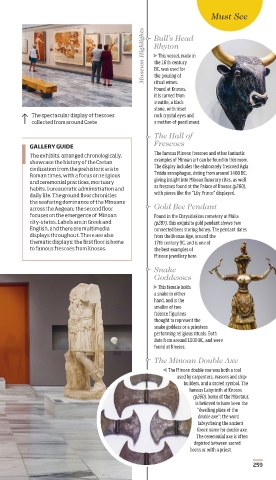
         The spectacular display of frescoes   rock crystal eyes and
         collected from around Crete     a mother-of-pearl snout.
                                         The Hall of
         GALLERY GUIDE                   Frescoes
         The exhibits, arranged chronologically,   The famous Minoan frescoes and other fantastic
         showcase the history of the Cretan   examples of Minoan art can be found in this room.
         civilization from the prehistoric era to   The display includes the elaborately frescoed Agía
         Roman times, with a focus on religious   Triáda sarcophagus, dating from around 1400 BC,
         and ceremonial practices, mortuary   giving insight into Minoan funerary rites, as well
         habits, bureaucratic administration and   as frescoes found at the Palace of Knosos  (p260),
         daily life. The ground floor chronicles   with pieces like the “Lily Prince” displayed.
         the seafaring dominance of the Minoans
         across the Aegean; the second floor   Gold Bee Pendant
         focuses on the emergence of  Minoan   Found in the Chrysólakkos cemetery at Mália
         city-states. Labels are in Greek and   (p287), this exquisite gold pendant shows two
         English, and there are multimedia   connected bees storing honey. The pendant dates
         displays throughout. There are also   from the Bronze Age, around the
         thematic displays: the first floor is home   17th century BC, and is one of
         to famous frescoes from Knosos.   the best examples of
                                         Minoan jewellery here.
                                         Snake
                                         Goddesses
                                         ▶  This female holds
                                         a snake in either
                                         hand, and is the
                                         smaller of two
                                         faïence figurines
                                         thought to represent the
                                         snake goddess or a priestess
                                         performing religious rituals. Both
                                         date from around 1600 BC, and were
                                         found at Knosos.
                                         The Minoan Double Axe
                                           ◀  The Minoan double axe was both a tool
                                              used by carpenters, masons and ship-
                                                builders, and a sacred symbol. The
                                                  famous Labyrinth at Knosos
                                                   (p260), home of the Minotaur,
                                                   is believed to have been the
                                                    “dwelling place of the
                                                    double axe”; the word
                                                    labrys being the ancient
                                                    Greek name for double axe.
                                                   The ceremonial axe is often
                                                   depicted between sacred
                                                  horns or with a priest.
                                                                  259


   258-259_EW_Greek_Islands.indd   259                       28/11/2018   09:56

