


Page 261 - (DK Eyewitness) Travel Guide - Greek Islands
P. 261
Must See


               c 2000 BC
               First palace period:   c 1370 BC     c 800 BC
               construction of the   Second palace   City- state of
               palace.         destroyed by fire.   Knosós emerges
        Timeline  7000 BC  1750–1700 BC  c 1100 BC        67 BC
                       First palace destroyed by
                                         Dorian invasion of Greece.
          Arrival of the
                                                          Roman
          first inhabitants
                       earthquake; construction
                                         End of Bronze Age and
                                                          conquest
          of Knosós.   of the second palace.  beginning of Dark Ages.  of Crete.
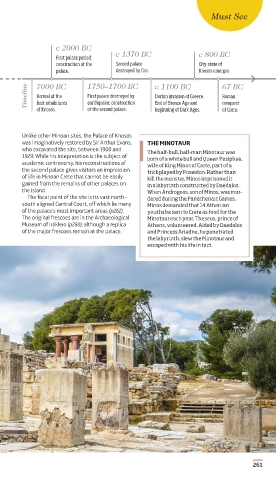
       Unlike other Minoan sites, the Palace of Knosós
       was imaginatively restored by Sir Arthur Evans,   THE MINOTAUR
       who excavated the site, between 1900 and   The half-bull, half-man Minotaur was
       1929. While his intepretation is the subject of   born of a white bull and Queen Pasiphaë,
       academic controversy, his reconstructions of   wife of King Minos of Crete, part of a
       the second palace gives visitors an impression   trick played by Poseidon. Rather than
       of life in Minoan Crete that cannot be easily   kill the monster, Minos imprisoned it
       gained from the remains of other palaces on   in a labyrinth constructed by Daedalos.
       the island.                     When Androgeos, son of Minos, was mur-
         The focal point of the site is its vast north–  dered during the Panathenaic Games,
       south aligned Central Court, off which lie many   Minos demanded that 14 Athenian
       of the palace’s most important areas (p262).   youths be sent to Crete as food for the
       The original frescoes are in the Archaeological   Minotaur each year. Theseus, prince of
       Museum of Irákleio (p280), although a replica   Athens, volunteered. Aided by Daedalos
       of the major frescoes remain at the palace.   and Princess Ariadne, he penetrated
                                       the labyrinth, slew the Minotaur and
                                       escaped with his life in tact.


                                                                  261


   260-263_EW_Greek_Islands.indd   261                       28/11/2018   09:56

