


Page 32 - All About History - Issue 18-14
P. 32
What was it like?


       AMSTERDA


                          In a period of dynamic change in the
           Netherlands O
                          Netherlands, Amsterdam served as a w
           Amsterdam O
                          beacon of freedom of religion, thought

                          speech during its golden age


            uled by a Catholic Spanish king ignorant of   As Protestant and Jewish refugees of religious
            their religious beliefs, Spanish colonies in   persecution flooded into the city, Amsterdam
            the Netherlands led a revolt in the mid-16th   transformed from a tiny port into one of the
            century which lasted longer than any other   foremost worldwide centres for trade and
       Rrebellion in European history. Although   commerce. Residents enjoyed intellectual toleran
        initially squashed by the Spanish king Philip II, the   denied in their own countries and books about
        mass uprising plunged Spain into a war against   religion, science and philosophy that could not
        the rebellious northern provinces. The northern   have been produced elsewhere found their way
        districts took advantage of their financially crippled   across oceans from what was now the publishing
        enemy and established the Republic of the Seven   house of the world. In this progressive atmosphe
        United Netherlands in 1581. The war waged on and   artists turned their attention from the lofty biblical
        much of the southern Netherlands remained under   scenes of old to finding the subtle beauty in
        Spanish rule, but the new republic threw its doors   everyday scenes of realism. This was Amsterdam’s
        open to a whole new world of trade, education and   golden age, where the city enjoyed its greatest-ever
        religious freedom.                      period of cultural and financial prosperity.
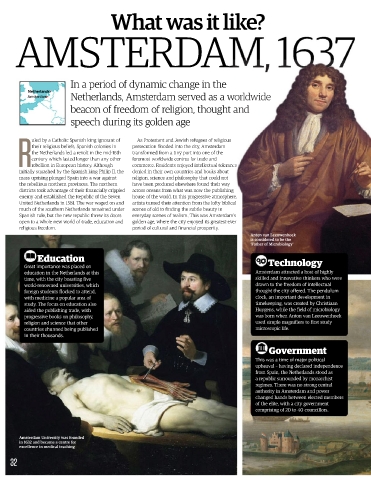
                                                                                         Anton van Leeuwenhoek
                                                                                         is considered to be the
                                                                                         ‘Father of Microbiology’
              Education

          Great importance was placed on                                                       Technology
          education in the Netherlands at this                                             Amsterdam attracted a host of highly
          time, with the city boasting five                                                skilled and innovative thinkers who were
          world-renowned universities, which                                               drawn to the freedom of intellectual
          foreign students flocked to attend,                                              thought the city offered. The pendulum
          with medicine a popular area of                                                  clock, an important development in
          study. The focus on education also                                               timekeeping, was created by Christiaan
          aided the publishing trade, with                                                 Huygens, while the field of microbiology
          progressive books on philosophy,                                                 was born when Anton van Leeuwenhoek
          religion and science that other                                                  used simple magnifiers to first study
          countries shunned being published                                                microscopic life.
          in their thousands.

                                                                                               Government
                                                                                           This was a time of major political
                                                                                           upheaval – having declared independence
                                                                                           from Spain, the Netherlands stood as
                                                                                           a republic surrounded by monarchist
                                                                                           regimes. There was no strong central
                                                                                           authority in Amsterdam and power
                                                                                           changed hands between elected members
                                                                                           of the elite, with a city government
                                                                                           comprising of 20 to 40 councillors.


        Amsterdam University was founded
        in 1632 and became a centre for
        excellence in medical teaching


     32

