


Page 33 - All About History - Issue 18-14
P. 33
What was it like?


                                                                                                            AMSTERDAM, 1637


                                                  Industry

                                              As Antwerp, previously Europe’s foremost
                                              sugar refiner, fell during the Eighty
                                              Years’ War, Amsterdam took its place and
                                              increased its sugar refineries from three
                                              to 50 in just 60 years. Dairy farming and   The urban merchant class rose to
                                                                                prosperity in Dutch society
                                              grain production rose rapidly as the city’s
                                              landscape was transformed, with its lakes
                                              being turned into polders. Another major
                                              industry was textiles, increasing from
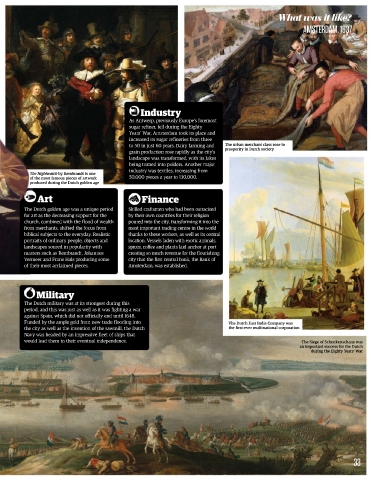
            The Nightwatch by Rembrandt is one
            f the most famous pieces of artwork   50,000 pieces a year to 130,000.
            roduced during the Dutch golden age
              Art                                   Finance

          The Dutch golden age was a unique period   Skilled craftsmen who had been ostracised
          for art as the decreasing support for the   by their own countries for their religion
          church, combined with the flood of wealth   poured into the city, transforming it into the
          from merchants, shifted the focus from   most important trading centre in the world
          biblical subjects to the everyday. Realistic   thanks to these workers, as well as its central
          portraits of ordinary people, objects and   location. Vessels laden with exotic animals,
          landscapes soured in popularity with   spices, coffee and plants laid anchor at port
          masters such as Rembrandt, Johannes   creating so much revenue for the flourishing
          Vermeer and Frans Hals producing some   city that the first central bank, the Bank of
          of their most acclaimed pieces.     Amsterdam, was established.


              Military

          The Dutch military was at its strongest during this
          period, and this was just as well as it was fighting a war
          against Spain, which did not officially end until 1648.
          Funded by the ample gold from new trade flooding into                  The Dutch East India Company was
          the city as well as the invention of the sawmill, the Dutch            thefirst-evermultinationalcorporation
          Navy was headed by an impressive fleet of ships that
          would lead them to their eventual independence.                                                  The Siege of Schenkenschans was
                                                                                                          an important success for the Dutch
                                                                                                              during the Eighty Years’ War


                                                                                                                             33

