


Page 92 - (DK Eyewitness) Travel Guide - Cuba
P. 92
90  ❯❯  Cuba Area by Area

     Wildlife


         Mangroves
     1                        (see p52). A successful breeding
                              program has brought the species
         Growing at the boundary
     of land and sea, mangroves form    back from the edge of extinction.
     a tangled web of interlocking roots
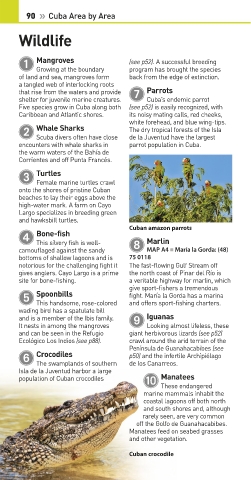
                                  Parrots
     that rise from the waters and provide   7
     shelter for juvenile marine creatures.   Cuba’s endemic parrot
     Five species grow in Cuba along both  (see p52) is easily recognized, with
     Caribbean and Atlantic shores.  its noisy mating calls, red cheeks,
                              white forehead, and blue wing-tips.
         Whale Sharks
     2                        The dry tropical forests of the Isla
                              de la Juventud have the largest
         Scuba divers often have close
     encounters with whale sharks in    parrot pop ulation in Cuba.
     the warm waters of the Bahía de
     Corrientes and off Punta Francés.
         Turtles
     3
         Female marine turtles crawl
     onto the shores of pristine Cuban
     beaches to lay their eggs above the
     high-water mark. A farm on Cayo
     Largo specializes in breeding green
     and hawksbill turtles.
                              Cuban amazon parrots
         Bone-fish
     4                            Marlin
         This silvery fish is well-
     camouflaged against the sandy   8
                                  MAP A4  •  María la Gorda: (48)
     bottoms of shallow lagoons and is   75 0118
     notorious for the challenging fight it   The fast-flowing Gulf Stream off
     gives anglers. Cayo Largo is a prime   the north coast of Pinar del Río is
     site for bone-fishing.   a veritable highway for marlin, which
                              give sport-fishers a tremendous
         Spoonbills
     5                        fight. María la Gorda has a marina
                              and offers sport-fishing charters.
         This handsome, rose-colored
     wading bird has a spatulate bill
                                  Iguanas
     and is a member of the Ibis family.    9
     It nests in among the mangroves    Looking almost lifeless, these
     and can be seen in the Refugio   giant herbivorous lizards (see p52)
     Ecológico Los Indios (see p88).  crawl around the arid terrain of the
                              Península de Guanahacabibes (see
         Crocodiles
     6                        p50) and the infertile Archi piélago
         The swamplands of southern
                              de los Canarreos.
     Isla de la Juventud harbor a large
                                     Manatees
     population of Cuban crocodiles   0
                                     These endangered
                                 marine mammals inhabit the
                                 coastal lagoons off both north
                                 and south shores and, although
                                 rarely seen, are very common
                                off the Golfo de Guanahacabibes.
                              Manatees feed on sea bed grasses
                              and other vegetation.
                              Cuban crocodile
 090-091_Top_10_Cuba.indd   90                        27/06/2016   15:51

