


Page 162 - (DK Eyewitness) Travel Guide - Sardinia
P. 162
160 SARDINIA AREA B Y AREA
p Tour of the Logudoro
After the fall of the Roman Empire, Sardinia did not return
to a central role in the Mediterranean until after the year
1000, when Pisan and Genoese merchants, soldiers and
preachers came into contact with the different regional
cultures of the island. The Romanesque churches in the
north of Sardinia are the result of these encounters. It is
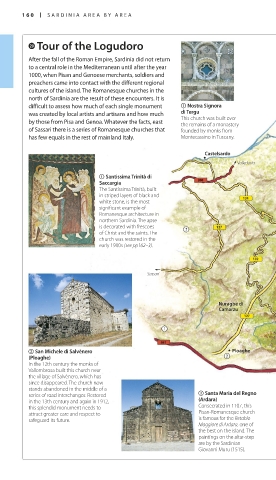
difficult to assess how much of each single monument 7 Nostra Signora
was created by local artists and artisans and how much di Tergu
This church was built over
by those from Pisa and Genoa. Whatever the facts, east the remains of a monastery
of Sassari there is a series of Romanesque churches that founded by monks from
has few equals in the rest of mainland Italy. Montecassino in Tuscany.
Castelsardo
Valledoria
1 Santissima Trinità di
Saccargia
The Santissima Trinità, built
in striped layers of black and
white stone, is the most
significant example of
Romanesque architecture in Perfugas
northern Sardinia. The apse
is decorated with frescoes
of Christ and the saints. The
church was restored in the
early 1900s (see pp162–3).
Sassari
Nuragbe di
Camarzu
2 San Michele di Salvènero Ploaghe
(Ploaghe)
In the 12th century the monks of
Vallombrosa built this church near
the village of Salvènero, which has
since disappeared. The church now
stands abandoned in the middle of a
series of road interchanges. Restored 3 Santa Maria del Regno
in the 13th century and again in 1912, (Ardara)
this splendid monument needs to Consecrated in 1107, this
attract greater care and respect to Pisan-Romanesque church
safeguard its future. is famous for the Retablo
Maggiore di Ardara, one of
the best on the island. The
paintings on the altar-step
are by the Sardinian
Giovanni Muru (1515).
160-161_EW_Sardinia.indd 160 11/2/16 12:03 PM
Eyewitness Travel LAYERS PRINTED:
Catalogue template “UK” LAYER
(Source v2.4)
Date 25th April 2013
Size 125mm x 217mm

