


Page 164 - (DK Eyewitness) Travel Guide - Sardinia
P. 164
162 SARDINIA AREA B Y AREA
a Santissima Trinità di Saccargia
Both simple and impressive, Sardinia’s most famous Romanesque
church stands in the middle of a windswept valley. Its name
probably derives from sa acca argia, “the dappled cow”. According
to legend, this animal used to kneel in prayer on the site, which is
why there are carvings of the cow on four sides of one of the
capitals in the portico. Another account relates how, around the
year 1112, the ruler of the region, Constantine, donated the small
church to the Camaldolesi monks, who then decided to enlarge it
with the help of Tuscan architects, craftsmen and labourers. Initially
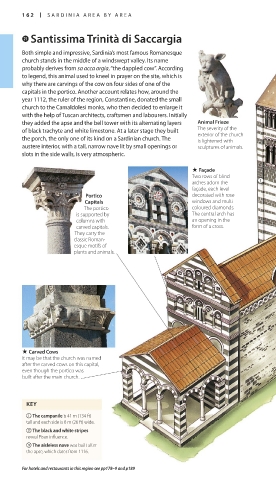
they added the apse and the bell tower with its alternating layers Animal Frieze
of black trachyte and white limestone. At a later stage they built The severity of the
exterior of the church
the porch, the only one of its kind on a Sardinian church. The is lightened with
austere interior, with a tall, narrow nave lit by small openings or sculptures of animals.
slots in the side walls, is very atmospheric.
. Façade
Two rows of blind
arches adorn the
façade, each level
Portico decorated with rose
Capitals windows and multi
The portico coloured diamonds.
is supported by The central arch has
columns with an opening in the
carved capitals. form of a cross.
They carry the
classic Roman
esque motifs of
plants and animals.
. Carved Cows
It may be that the church was named
after the carved cows on this capital,
even though the portico was
built after the main church.
KEY
1 The campanile is 41 m (134 ft)
tall and each side is 8 m (26 ft) wide.
2 The black and white stripes
reveal Pisan influence.
3 The aisleless nave was built after
the apse, which dates from 1116.
For hotels and restaurants in this region see pp178–9 and p189
162-163_EW_Sardinia.indd 162 11/2/16 2:12 PM

