


Page 123 - (DK) Super Shark Encyclopedia: And Other Creatures of the Deep
P. 123
COSTUME


                                                                        CHANGER


                                                                          ZEBRA SHARK


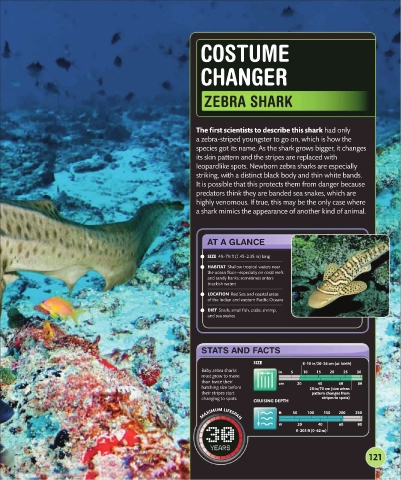
                                                                       The first scientists to describe this shark had only
                                                                       a zebra-striped youngster to go on, which is how the
                                                                       species got its name. As the shark grows bigger, it changes
                                                                       its skin pattern and the stripes are replaced with
                                                                       leopardlike spots. Newborn zebra sharks are especially
                                                                       striking, with a distinct black body and thin white bands.
                                                                       It is possible that this protects them from danger because
                                                                       predators think they are banded sea snakes, which are
                                                                       highly venomous. If true, this may be the only case where
                                                                       a shark mimics the appearance of another kind of animal.


                                                                           AT A GLANCE

                                                                        •  SIZE  4¾–7¾ ft (1.45–2.35 m) long
                                                                        •  HABITAT  Shallow tropical waters near
                                                                           the ocean floor—especially on coral reefs
                                                                           and sandy banks; sometimes enters
                                                                           brackish waters
                                                                        •  LOCATION  Red Sea and coastal areas
                                                                           of the Indian and western Pacific Oceans
                                                                        •  DIET  Snails, small fish, crabs, shrimp,
                                                                           and sea snakes


                                                                         STATS AND FACTS

                                                                                           SIZE              8–10 in/20–26 cm (at  birth)
                                                                         Baby zebra sharks
                                                                                                    in   5   10   15   20  25   30
                                                                         must grow to more
                                                                         than twice their
                                                                                                    cm     20     40      60    80
                                                                         hatching size before                  28 in/70 cm (size when
                                                                         their stripes start                    pattern changes from
                                                                         changing to spots.                         stripes to spots)
                                                                                           CRUISING DEPTH
                                                                                                    ft   50    100  150   200   250
                                                                         MAXIMUM LIFESPAN           m      20     40      60    80
                                                                          30                              0–203 ft ft (0–62 m)


                                                                            YEARS
                                                                                                                                    121

