


Page 127 - (DK) Super Shark Encyclopedia: And Other Creatures of the Deep
P. 127
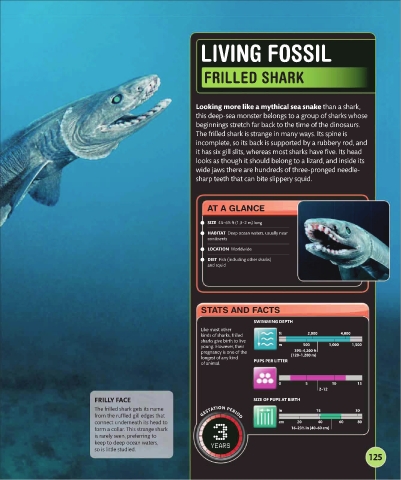
LIVING FOSSIL


                                                                          FRILLED SHARK


                                                                       Looking more like a mythical sea snake than a shark,
                                                                       this deep-sea monster belongs to a group of sharks whose
                                                                       beginnings stretch far back to the time of the dinosaurs.
                                                                       The frilled shark is strange in many ways. Its spine is
                                                                       incomplete, so its back is supported by a rubbery rod, and
                                                                       it has six gill slits, whereas most sharks have five. Its head
                                                                       looks as though it should belong to a lizard, and inside its
                                                                       wide jaws there are hundreds of three-pronged needle-
                                                                       sharp teeth that can bite slippery squid.


                                                                           AT A GLANCE

                                                                        •  SIZE  4¼–6½ ft (1.3–2 m) long

                                                                        •  HABITAT  Deep ocean waters, usually near
                                                                           continents
                                                                        •  LOCATION  Worldwide
                                                                        •  DIET  Fish (including other sharks)
                                                                           and squid


                                                                         STATS AND FACTS

                                                                                           SWIMMING DEPTH
                                                                         Like most other
                                                                                                    ft         2,000      4,000
                                                                         kinds of sharks, frilled
                                                                         sharks give birth to live
                                                                                                    m        500      1,000   1,500
                                                                         young. However, their
                                                                                                          395–4,200 ft
                                                                         pregnancy is one of the         (120–1,280 m)
                                                                         longest of any kind    PUPS PER LITTER
                                                                         of animal.

                                                                                                    0         5        10       15
                                                                                                                   2–12
                                   FRILLY FACE                                             SIZE OF PUPS AT BIRTH
                                   The frilled shark gets its name                                  in            15            30
                                   from the ruffled gill edges that       GESTATION PERIOD
                                   connect underneath its head to                                   cm     20     40      60    80
                                   form a collar. This strange shark         3                           16–23½ in (40–60 cm)
                                   is rarely seen, preferring to
                                   keep to deep ocean waters,               YEARS
                                   so is little studied.
                                                                                                                                    125

