


Page 131 - (DK) Super Shark Encyclopedia: And Other Creatures of the Deep
P. 131
STRANDING


                                                                        SURVIVOR


                                                                          BLIND SHARK


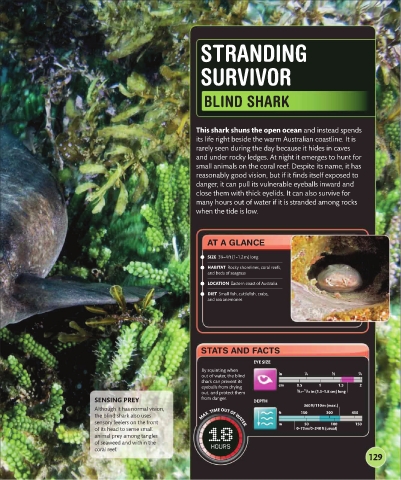
                                                                       This shark shuns the open ocean and instead spends
                                                                       its life right beside the warm Australian coastline. It is
                                                                       rarely seen during the day because it hides in caves
                                                                       and under rocky ledges. At night it emerges to hunt for
                                                                       small animals on the coral reef. Despite its name, it has
                                                                       reasonably good vision, but if it finds itself exposed to
                                                                       danger, it can pull its vulnerable eyeballs inward and
                                                                       close them with thick eyelids. It can also survive for
                                                                       many hours out of water if it is stranded among rocks
                                                                       when the tide is low.


                                                                           AT A GLANCE

                                                                        •  SIZE  3¼–4 ft (1–1.2    m) long
                                                                        •  HABITAT  Rocky shorelines, coral reefs,
                                                                           and beds of seagrass
                                                                        •  LOCATION  Eastern coast of Australia
                                                                        •  DIET  Small fish, cuttlefish, crabs,
                                                                           and sea anemones


                                                                         STATS AND FACTS

                                                                                           EYE SIZE
                                                                         By squinting when
                                                                                                    in       1         1         3
                                                                         out of water, the blind              ⁄4        ⁄2       ⁄4
                                                                         shark can prevent its
                                                                                                    cm     0.5     1      1.5    2
                                                                         eyeballs from drying
                                                                                                             11
                                                                                                           9 ⁄16– ⁄16 in (1.5–1.8 cm) long
                                                                         out, and protect them
                                   SENSING PREY                          from danger.      DEPTH
                                                                                                             360 ft/110 m (max.)
                                   Although it has normal vision,
                                                                                                    ft      150      300      450
                                   the blind shark also uses
                                   sensory feelers on the front          MAX. TIME OUT OF WATER     m        50        100      150
                                   of its head to sense small              18                              0–73 m/0–240 ft (usual)
                                   animal prey among tangles
                                   of seaweed and within the                HOURS
                                   coral reef.
                                                                                                                                    129

