


Page 192 - (DK) Super Shark Encyclopedia: And Other Creatures of the Deep
P. 192
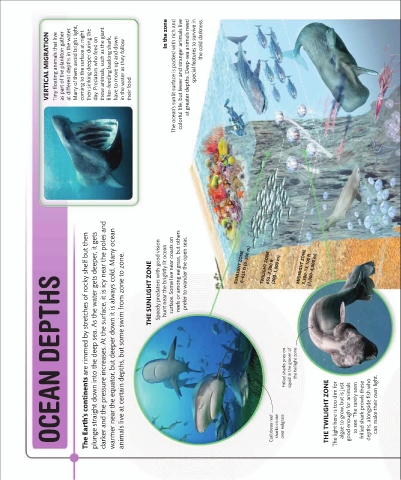
VERTICAL MIGRATION Tiny floating animals that live  as part of the plankton gather   at different depths in the water.  Many of them avoid bright light,  coming to the surface at night  then sinking deeper during the  day. Predators who feed on  these animals, such as the giant  filter-feeding basking shark,  have to move up and down   in the water as they follow    their food.  In the zone The ocean’s sunlit surface is packed with rich and  colorful life, but fewer and stranger animals live  at greater depths. Deep-sea animals need     special f


                                       darker and the pressure increases. At the surface, it is icy near the poles and
                                          warmer near the equator, but deeper down it is always cold. Many ocean
                                   plunge straight down into the deep sea. As the water gets deeper, it gets
                                The Earth’s continents are rimmed by stretches of rocky shelf but then


                                             animals live at certain depths, but some swim from zone to zone.
                                                       THE SUNLIGHT ZONE Speedy predators with good vision  hunt near the brightly lit ocean  surface. Some live near coasts on  reefs or among eelgrass, but others  prefer to wander the open seas.  SUNLIGHT ZONE  0–655 ft (0–200 m)  TWILIGHT ZONE 655–3,300 ft  (200–1,000 m)  MIDNIGHT ZONE 3,300–13,100 ft    (1,000–4,000 m)

                      OCEAN DEPTHS


                                                                                                       Frilled sharks prey on   squid in the gloom of     the twilight zone


                                                                                                  Caribbean reef   sharks cruise   over eelgrass  THE TWILIGHT ZONE  The light here is too dim for  algae to grow, but is just  good enough for animals   to see. The rarely seen  frilled shark prowls these  depths, alongside fish who  can make their own light.

