


Page 193 - (DK) Super Shark Encyclopedia: And Other Creatures of the Deep
P. 193
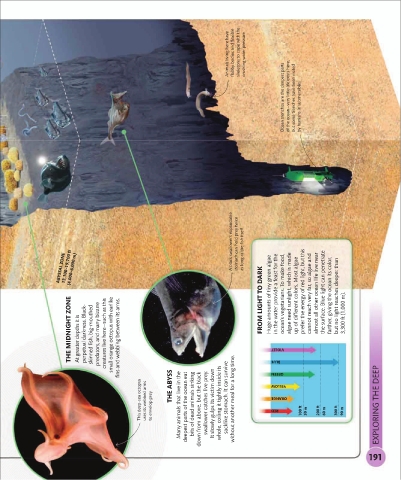
Animals living here have  flabby bodies and flexible  skeletons to cope with the   crushing water pressure


                                                                                                      Ocean trenches are the deepest parts   of the ocean—very little life exists here,  but some trenches have been visited   by humans in submersibles


                                                                                    A black swallower’s expandable  stomach can hold prey twice   as long as the fish itself


                      ABYSSAL ZONE  13,100–19,700 ft  (4,000–6,000 m)                            Huge amounts of tiny green algae   in the water provide a feast for the  ocean’s vegetarians. To make food,  algae need sunlight, which is made  up of different colors. Most algae  prefer the energy of red light, but this  cannot reach very far, so algae and  almost all other ocean life live near  the surface. Blue light can penetrate  farther, giving the ocean its color,   but no light reaches deeper than


                          THE MIDNIGHT ZONE  At greater depths it is  perpetual darkness. Black- skinned fish, big-mouthed  predators, and many bizarre  creatures live here—such as this  small orange octopus with earlike  fins and webbing between its arms.  FROM LIGHT TO DARK  BLUE  VIOLET  3,300 ft (1,000 m).


                                                   This deep-sea octopus   uses its webbed arms   to envelop prey  THE ABYSS Many animals that live in the  deepest parts of the ocean eat  bits of dead animals sinking  down from above, but the black  swallower catches live prey.     It slowly gulps its victim down  whole, coiling it tightly inside its  sacklike stomach. It can survive  without another meal for a long time.  RED  GREEN  YELLOW  ORANGE  100 ft  30 m  200 ft  60 m  300 ft  90 m  EXPLORING THE DEEP


                                                                                                                                    191

