


Page 110 - (DK Eyewitness) Travel Guide - Japan
P. 110
EAT
Takashimaya
The recipe for the sauce
used at Takashimya eel
EXPERIENCE Central Tokyo its discerning clientele.
shop has not been
altered since the eatery
opened in 1875. What’s
more, this venerable
restaurant doesn’t just
serve up any old eel to
Only the Kyosui unagi,
a slow-growing and
richer flavored sub-
species of the fish, will
be found in the kitchen
here. A bento option for
take out is available.
J6 ⌂ 11-11-15
Nihonbashikobunachō,
Chūō-ku ¢ Sun
∑ takashimaya.info
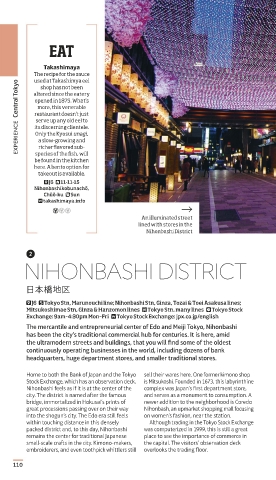
An illuminated street
lined with stores in the
Nihonbashi District
2
NIHONBASHI DISTRICT
日本橋地区
J6 Tokyo Stn, Marunouchi line; Nihonbashi Stn, Ginza, Tozai & Toei Asakusa lines;
Mitsukoshimae Stn, Ginza & Hanzomon lines £ Tokyo Stn, many lines # Tokyo Stock
Exchange: 9am–4:30pm Mon–Fri ∑ Tokyo Stock Exchange: jpx.co.jp/english
The mercantile and entrepreneurial center of Edo and Meiji Tokyo, Nihonbashi
has been the city’s traditional commercial hub for centuries. It is here, amid
the ultramodern streets and buildings, that you will find some of the oldest
continuously operating businesses in the world, including dozens of bank
headquarters, huge department stores, and smaller traditional stores.
Home to both the Bank of Japan and the Tokyo sell their wares here. One former kimono shop
Stock Exchange, which has an observation deck, is Mitsukoshi. Founded in 1673, this labyrinthine
Nihonbashi feels as if it is at the center of the complex was Japan’s first department store,
city. The district is named after the famous and serves as a monu ment to consumption. A
bridge, immortalized in Hokusai’s prints of newer addition to the neighborhood is Coredo
great processions passing over on their way Nihonbash, an upmarket shopping mall focusing
into the shogun’s city. The Edo era still feels on women’s fashion, near the station.
within touching distance in this densely Although trading in the Tokyo Stock Exchange
packed district and, to this day, Nihonbashi was computerized in 1999, this is still a great
remains the center for traditional Japanese place to see the importance of commerce in
small-scale crafts in the city. Kimono-makers, the capital. The visitors’ observation deck
embroiderers, and even toothpick whittlers still overlooks the trading floor.
110
110-111_EW_Japan.indd 110 04/02/2019 14:54
EW Must-see template v2.1 – 18th October 2018
Fonts: Aptifer Sans LT Pro, Posterama Text, Soho Gothic
Pro, Soho Pro, ITC Caslon 224

