


Page 112 - (DK Eyewitness) Travel Guide - Japan
P. 112
3 '
IMPERIAL PALACE
皇居
G6 Nijubashimae Stn, Chiyoda line; Otemachi Stn, many lines
EXPERIENCE Central Tokyo mid-Apr, Sep & Oct; to 5pm mid-Apr–Aug) ∑kunaicho.go.jp
£ Tokyo Stn, many lines # Imperial Palace: Jan 2, Dec 23; East Gardens
of the Imperial Palace: 9am–4pm Tue–Thu, Sat & Sun (to 4:30pm May–
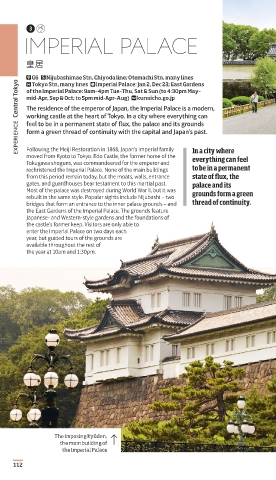
The residence of the emperor of Japan, the Imperial Palace is a modern,
working castle at the heart of Tokyo. In a city where everything can
feel to be in a permanent state of flux, the palace and its grounds
form a green thread of continuity with the capital and Japan’s past.
Following the Meiji Restoration in 1868, Japan’s imperial family
moved from Kyoto to Tokyo. Edo Castle, the former home of the In a city where
everything can feel
Tokugawa shoguns, was commandeered for the emperor and
rechristened the Imperial Palace. None of the main buildings to be in a permanent
from this period remain today, but the moats, walls, entrance state of flux, the
gates, and guardhouses bear testament to this martial past. palace and its
Most of the palace was destroyed during World War II, but it was grounds form a green
rebuilt in the same style. Popular sights include Nijubashi – two
bridges that form an entrance to the inner palace grounds – and thread of continuity.
the East Gardens of the Imperial Palace. The grounds feature
Japanese- and Western-style gardens and the foundations of
the castle’s former keep. Visitors are only able to
enter the Imperial Palace on two days each
year, but guided tours of the grounds are
available throughout the rest of
the year at 10am and 1:30pm.
The imposing Kyūden,
the main building of
the Imperial Palace
112
112-113_EW_Japan.indd 112 04/02/2019 14:54
EW Catalogue template v3.0 – 12th July 2018
Fonts: Aptifer Sans LT Pro, Posterama Text, Soho Gothic
Pro, Soho Pro, ITC Caslon 224

