


Page 173 - (DK Eyewitness) Travel Guide - Japan
P. 173
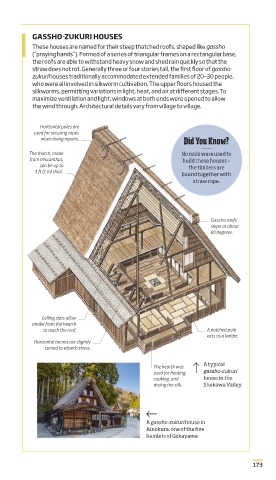
GASSHO-ZUKURI HOUSES
         These houses are named for their steep thatched roofs, shaped like gassho
         (“praying hands”). Formed of a series of triangular frames on a rectangular base,

         the roofs are able to withstand heavy snow and shed rain quickly so that the
         straw does not rot. Generally three or four stories tall, the first floor of gassho-
         zukuri houses traditionally accommodated extended families of 20–30 people,
         who were all involved in silkworm culti vation. The upper floors housed the
         silk worms, permitting variations in light, heat, and air at different stages. To
         maximize venti lation and light, windows at both ends were opened to allow
         the wind through. Architectural details vary from village to village.


           Horizontal poles are
          used for securing ropes
            when doing repairs.                 Did You Know?
         The thatch, made                       No nails were used to
         from miscanthus,                       build these houses –
           can be up to                          the timbers are
          3 ft (1 m) thick.
                                                bound together with
                                                   straw rope.


                                                       Gassho roofs
                                                       slope at about
                                                       60 degrees.


            Ceiling slats allow
         smoke from the hearth
            to reach the roof.                        A notched pole
                                                      acts as a ladder.
          Horizontal beams are slightly
             curved to absorb stress.

                                                     A typical
                                        The hearth was
                                        used for heating,   gassho-zukuri
                                        cooking, and   house in the
                                        drying the silk.  Shokawa Valley


                                       A gassho-zukuri house in
                                       Ainokura, one of the five
                                       hamlets of Gokayama


                                                                  173


   172-173_EW_Japan.indd   173                               04/02/2019   17:03

