


Page 177 - (DK Eyewitness) Travel Guide - Japan
P. 177
THE LAYOUT OF A ZEN
         BUDDHIST TEMPLE
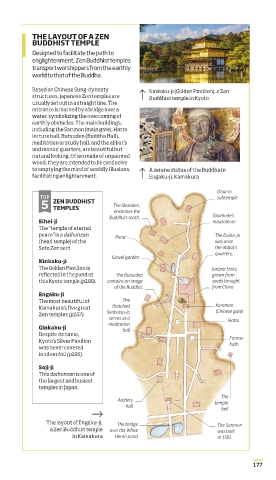
         Designed to facilitate the path to
         englightenment, Zen Buddhist temples
         transport worshippers from the earthly
         world to that of the Buddha.

         Based on Chinese Sung-dynasty   Kinkaku-ji (Golden Pavilion), a Zen
         structures, Japanese Zen temples are   Buddhist temple in Kyoto
         usually set out in a straight line. The
         entrance is marked by a bridge over a
         water, symbolizing the overcoming of
         earthly obstacles. The main buildings,
         including the Sanmon (main gate), Hatto
         lecture hall, Butsuden (Buddha Hall),
         medi tation or study hall, and the abbot’s
         and monks’ quar ters, are beautiful but
         natural looking. Often made of unpainted
         wood, they are intended to be condu cive
         to emptying the mind of worldly illusions,   A serene statue of the Buddha in
         facilitating enlightenment.   Engaku-ji, Kamakura
                                                         Obai-in
           TOP  ZEN BUDDHIST                             subtemple
            5  TEMPLES        The Shariden,
                              enshrines the
                             Buddha’s tooth.            Tokimune’s
           Eihei-ji                                     mausoleum
           The “temple of eternal
           peace” is a daihonzan   Pond                 The Daiho-jo
           (head temple) of the                         was once
           Soto Zen sect.                               the abbot’s
                                                        quarters.
                              Gravel garden
           Kinkaku-ji
           The Golden Pavilion is                      Juniper trees,
           reflected in the pond at   The Butsuden     grown from
           this Kyoto temple (p199).  contains an image   seeds brought
                              of the Buddha.           from China
           Engaku-ji
           The most beautiful of   The
           Kamakura’s five great   thatched             Karamon
                                                        (Chinese gate)
           Zen temples (p157).  Senbutsu-jo
                             serves as a                    Hatto
           Ginkaku-ji        meditation
                                 hall
           Despite its name,                                Former
           Kyoto’s Silver Pavilion                          bath
           was never covered
           in silver foil (p195).
           Soji-ji
           This daihonzan is one of
           the largest and busiest
           temples in Japan.
                                                          The
                               Archery                  temple
                                 hall
                                                          bell
             The layout of Engaku-ji,     The bridge     The Sanmon
              a Zen Buddhist temple     over the White   was built
                    in Kamakura  Heron pond              in 1783.


                                                                  177


   176-177_EW_Japan.indd   177                               04/02/2019   15:57

