


Page 181 - (DK Eyewitness) Travel Guide - Japan
P. 181
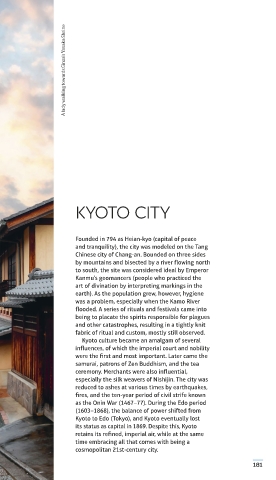
A lady walking towards Ginza’s Yasaka Shrine


                    KYOTO CITY


                    Founded in 794 as Heian-kyo (capital of peace
                    and tranquility), the city was modeled on the Tang
                    Chinese city of Chang-an. Bounded on three sides
                    by mountains and bisected by a river flowing north
                    to south, the site was considered ideal by Emperor
                    Kanmu’s geo mancers (people who practiced the
                    art of divination by interpreting markings in the
                    earth). As the population grew, however, hygiene
                    was a problem, especially when the Kamo River
                    flooded. A series of rituals and festivals came into
                    being to placate the spirits responsible for plagues
                    and other catastrophes, result ing in a tightly knit
                    fabric of ritual and custom, mostly still observed.
                      Kyoto culture became an amalgam of several
                    influences, of which the imperial court and nobility
                    were the first and most important. Later came the
                    samurai, patrons of Zen Buddhism, and the tea
                    ceremony. Merchants were also influential,
                    especially the silk weavers of Nishijin. The city was
                    reduced to ashes at various times by earthquakes,
                    fires, and the ten-year period of civil strife known
                    as the Onin War (1467–77). During the Edo period
                    (1603–1868), the balance of power shifted from
                    Kyoto to Edo (Tokyo), and Kyoto eventually lost
                    its status as capital in 1869. Despite this, Kyoto
                    retains its refined, imperial air, while at the same
                    time embracing all that comes with being a
                    cosmopolitan 21st-century city.
                                                                  181


   180-181_EW_Japan.indd   181                               04/02/2019   15:57

