


Page 230 - (DK Eyewitness) Travel Guide - Japan
P. 230
6 "
          MIYAJIMA ISLAND


        宮島
        ! B5   ⌂ Hiroshima Prefecture   £ From Hiroshima to Miyajima-guchi, then ferry
      EXPERIENCE  Western Honshu  Miyajima, as this sacred place is commonly known, means shrine island, although
         g From Hiroshima Port or Miyajima-guchi Stn   n At ferry terminal; www.visit-
        miyajima-japan.com/en
        its official name is Itsukushima. A UNESCO World Heritage Site, it is symbolized by
        Itsukushima Shrine’s prominent vermilion Otorii (Grand Gate) rising from the sea
        during low tide, and enchanting visitors for centuries.

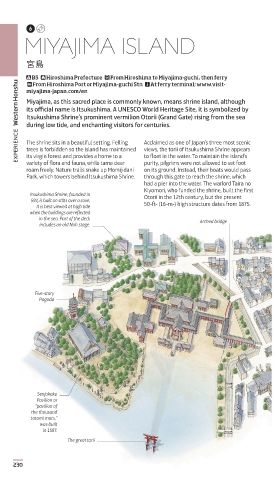
                                      Acclaimed as one of Japan’s three most scenic
        The shrine sits in a beautiful setting. Felling
        trees is forbidden so the island has maintained  views, the torii of Itsukushima Shrine appears
        its virgin forest and provides a home to a
        variety of flora and fauna, while tame deer
                                      purity, pilgrims were not allowed to set foot
                                      on its ground. Instead, their boats would pass
        roam freely. Nature trails snake up Momijidani   to float in the water. To maintain the island’s
        Park, which towers behind Itsukushima Shrine.  through this gate to reach the shrine, which
                                      had a pier into the water. The warlord Taira no
                                      Kiyomori, who funded the shrine, built the first
         Itsukushima Shrine, founded in   Otorii in the 12th century, but the present
         593, is built on stilts over a cove.
          It is best viewed at high tide   50-ft- (16-m-) high structure dates from 1875.
         when the buildings are reflected
           in the sea. Part of the deck             Arched bridge
           includes an old Noh stage.


          Five-story
           Pagoda


           Senjokaku
          Pavilion or
          “pavilion of
         the thousand
         tatami mats,”
           was built
            in 1587.
                  The great torii


    230


   230-231_EW_Japan.indd   230                               04/02/2019   15:57


 EW Must-see template v2.1 – 18th October 2018
 Fonts: Aptifer Sans LT Pro, Posterama Text, Soho Gothic
 Pro, Soho Pro, ITC Caslon 224

