


Page 235 - (DK Eyewitness) Travel Guide - Japan
P. 235
largely avoided the industrial   Taiji Whale Museum
                           development that scars much   "   ⌂ 2934-2 Taiji   § (0735)
                           of Japan’s Pacific coastline.  59-2400   # 8:30am–
                             From the small port town of   5pm daily
                           Shingu, on the east coast, you
                           can take a bus to Shiko, then
                           a 50-minute boat trip along   e
                           the Kumano River to Doro
                           Valley, a spectacular gorge.   Iga-Ueno
                           From May to June rhododen-  伊賀上野
                           drons and azaleas bloom on   ! D5   ⌂ Mie Prefecture   £
                           the river’s banks.  n 1st Floor, Haito-Pia bldg,
                             A 20-minute bus ride inland
                           from Shingu lies Nachi-no-taki,   in front of Ueno-shi Stn;
                                               (0595) 24-0270
                           Japan’s highest waterfall. A
                           stone path parallel to the falls   This castle town was the
                           leads to the ancient Nachi   birthplace of Japan’s revered
                           Taisha shrine. The next port   haiku poet Matsuo Basho and
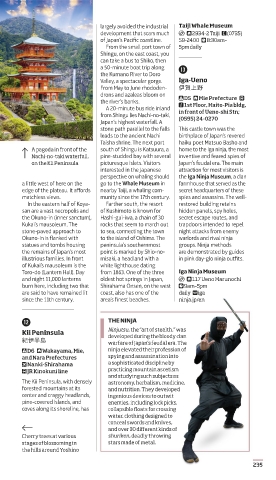
         A pagoda in front of the   south of Shingu is Katsuura, a   home to the Iga ninja, the most
         Nachi-no-taki waterfall,   pine-studded bay with several   inventive and feared spies of
         on the Kii Peninsula  picturesque islets. Visitors   Japan’s feudal era. The main
                           interested in the Japanese   attraction for most visitors is
                           perspective on whaling should   the Iga Ninja Museum, a clan
       a little west of here on the   go to the Whale Museum in   farmhouse that served as the
       edge of the plateau. It affords   nearby Taiji, a whaling com-  secret head quarters of these
       matchless views.    munity since the 17th century.   spies and assassins. The well-
         In the eastern half of Koya-    Farther south, the resort     restored building retains
       san are a vast necropolis and   of Kushimoto is known for   hidden panels, spy holes,
       the Okuno-in (inner sanctum),   Hashi-gui-iwa, a chain of 30   secret escape routes, and
       Kukai’s mausoleum. The   rocks that seem to march out     trapdoors intended to repel
       stone-paved approach to   to sea, connecting the town    night attacks from enemy
       Okuno-in is flanked with   to the island of Oshima. The   warlords and rival ninja
       statues and tombs housing   peninsula’s southernmost   groups. Ninja methods
       the remains of Japan’s most   point is marked by Shio-no-  are demon strated by guides
       illustrious families. In front    misaki, a headland with a   in pink day-glo ninja outfits.
       of Kukai’s mausoleum is the   white lighthouse dating
       Toro-do (Lantern Hall). Day   from 1863. One of the three   Iga Ninja Museum
       and night 11,000 lanterns   oldest hot springs in Japan,   "   ⌂ 117 Ueno Marunochi
       burn here, including two that   Shirahama Onsen, on the west   # 9am–5pm
       are said to have remained lit   coast, also has one of the   daily   ∑ iga
       since the 11th century.  area’s finest beaches.  ninja.jp/en


       w                     THE NINJA
       Kii Peninsula         Ninjutsu, the “art of stealth,” was
                             developed during the bloody clan
       紀伊半島                  warfare of Japan’s feudal era. The
       ! D6   ⌂ Wakayama, Mie,   ninja elevated their profession of
       and Nara Prefectures     spying and assassination into
       k Nanki-Shirahama      a sophisticated discipline by
       £ JR Kinokuni line    practicing mountain ascetism
                             and studying such subjects as
       The Kii Peninsula, with densely   astronomy, herbalism, medicine,
       forested mountains at its   and nutrition. They developed
       center and craggy headlands,   ingenious devices to outwit
       pine-covered islands, and   enemies, including lock picks,
       coves along its shoreline, has   collapsible floats for crossing
                             water, clothing designed to
                             conceal swords and knives,
                             and over 30 different kinds of
       Cherry trees at various   shuriken, deadly throwing
       stages of blossoming in    stars made of metal.
       the hills around Yoshino
                                                                  235


   234-235_EW_Japan.indd   235                               04/02/2019   15:57

