


Page 232 - (DK Eyewitness) Travel Guide - Japan
P. 232
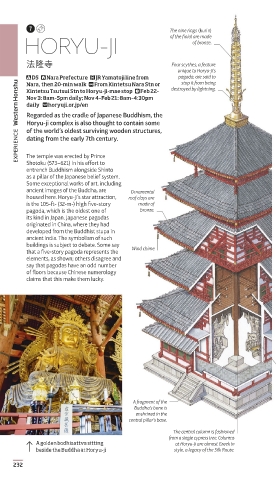
7 "                                  The nine rings (kurin)
          HORYU-JI                                of bronze.
                                             of the finial are made


        法隆寺                                  Four scythes, a feature
                                               unique to Horyu-ji’s
        ! D5   ⌂ Nara Prefecture   £ JR Yamatoji line from        destroyed by lightning.
                                               pagoda, are said to
                                                stop it from being
      EXPERIENCE  Western Honshu  daily    ∑ horyuji.or.jp/en
        Nara, then 20-min walk   @ From Kintetsu Nara Stn or
        Kintetsu Tsutsui Stn to Horyu-ji-mae stop   # Feb 22–
        Nov 3: 8am–5pm daily; Nov 4–Feb 21: 8am–4:30pm
        Regarded as the cradle of Japanese Buddhism, the
        Horyu-ji complex is also thought to contain some
        of the world’s oldest surviving wooden structures,
        dating from the early 7th century.
        The temple was erected by Prince
        Shotoku (573–621) in his effort to
        entrench Buddhism alongside Shinto
        as a pillar of the Japanese belief system.
        Some exceptional works of art, including
        ancient images of the Buddha, are   Ornamental
        housed here. Horyu-ji’s star attraction,     roof clays are
        is the 105-ft- (32-m-) high five-story   made of
        pagoda, which is the oldest one of    bronze.
        its kind in Japan. Japanese pagodas
        originated in China, where they had
        developed from the Buddhist stupa in
        ancient India. The symbolism of such
        buildings is sub ject to debate. Some say
        that a five-story pagoda represents the   Wind chime
        elements, as shown; others disagree and
        say that pagodas have an odd number
        of floors because Chinese numerology
        claims that this make them lucky.


                                   A fragment of the
                                   Buddha’s bone is
                                    enshrined in the
                                  central pillar’s base.
                                              The central column is fashioned
                                            from a single cypress tree. Columns
          A golden bodhisattva sitting        at Horyu-ji are almost Greek in
          beside the Buddha at Horyu-ji       style, a legacy of the Silk Route.
    232


   232-233_EW_Japan.indd   232                               04/02/2019   15:57


 EW Catalogue template v3.0 – 12th July 2018
 Fonts: Aptifer Sans LT Pro, Posterama Text, Soho Gothic
 Pro, Soho Pro, ITC Caslon 224

