


Page 242 - (DK Eyewitness) Travel Guide - Japan
P. 242
EXPERIENCE  Western Honshu


        26                  27                  Jonen-ji is noted for its finely
                                                carved gate, Hofuku-ji its
        Iwakuni             Hagi                bibbed Jizo statues, Kyotoku-ji
        岩国                  萩                   for its garden, and Choju-ji for
                                                an atmos pheric ceme tery.
        ! B5   ⌂ Yamaguchi   ! B5   ⌂ Yamaguchi   Camellias and natsu mikan
        Prefecture   £ Sanyo   Prefecture   £ @      (summer oranges) hanging
        Shinkansen line to Shin-  n (0838) 25-1750
        Iwakuni, JR Sanyo line                  over whitewashed mud walls
        to Iwakuni   n At 2F bus   Hagi was a minor fishing port   typify the samurai quarters to
                            until Mori Terumoto forti fied it
                                                the west of Teramachi. Sever al
        terminal near Iwakuni Stn;   in 1604. Mori samurai helped   residences are located here,
        (082) 721-6050
                            spark off the anti-Tokugawa   including Kikuya House, a
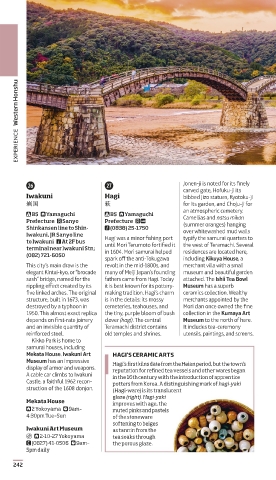
        This city’s main draw is the   revolt in the mid-1800s, and   merchant villa with a small
        elegant Kintai-kyo, or “brocade   many of Meiji Japan’s founding  museum and beautiful garden
        sash” bridge, named for the   fathers came from Hagi. Today   attached. The Ishii Tea Bowl
        rippling effect created by its   it is best known for its pottery-  Museum has a superb
        five linked arches. The ori ginal   making tradition. Hagi’s charm   ceramics collection. Wealthy
        structure, built in 1673, was   is in the details: its mossy   merchants appoint ed by the
        destroyed by a typhoon in   ceme teries, tea houses, and   Mori clan once owned the fine
        1950. This almost exact replica  the tiny, purple bloom of bush   collection in the Kumaya Art
        depends on first-rate joinery   clover (hagi). The central   Museum to the north of here.
        and an invisible quantity of   Teramachi district contains   It includes tea-ceremony
        reinforced steel.   old temples and shrines.   utensils, paintings, and screens.
          Kikko Park is home to
        samurai houses, including
        Mekata House. Iwakuni Art   HAGI’S CERAMIC ARTS
        Museum has an impressive   Hagi’s first kilns date from the Heian period, but the town’s
        display of armor and weapons.   reputation for refined tea vessels and other wares began
        A cable car climbs to Iwakuni   in the 16th century with the introduction of apprentice
        Castle, a faithful 1962 recon-  potters from Korea. A distinguishing mark of hagi-yaki
        struction of the 1608 donjon.  (Hagi-ware) is its translucent
                              glaze (right). Hagi-yaki
        Mekata House          improves with age, the
        ⌂ 2 Yokoyama   # 9am–  muted pinks and pastels
        4:30pm Tue–Sun        of the stone ware
                              softening to beiges
        Iwakuni Art Museum    as tannin from the
        "   ⌂ 2-10-27 Yokoyama     tea soaks through
        § (0827) 41-0506   # 9am–  the porous glaze.
        5pm daily
    242


   242-243_EW_Japan.indd   242                               04/02/2019   15:57


 EW Catalogue template v3.0 – 12th July 2018
 Fonts: Aptifer Sans LT Pro, Posterama Text, Soho Gothic
 Pro, Soho Pro, ITC Caslon 224

