


Page 247 - (DK Eyewitness) Travel Guide - Japan
P. 247
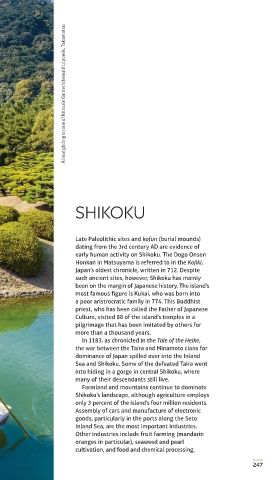
A boat gliding on one of Ritsurin Garden’s beautiful ponds, Takamatsu


                    SHIKOKU


                    Late Paleolithic sites and kofun (burial mounds)
                    dating from the 3rd century AD are evidence of
                    early human activity on Shikoku. The Dogo Onsen
                    Honkan in Matsuyama is referred to in the Kojiki,
                    Japan’s oldest chronicle, written in 712. Despite
                    such ancient sites, however, Shikoku has mainly
                    been on the margin of Japanese history. The island’s
                    most famous figure is Kukai, who was born into
                    a poor aristrocratic family in 774. This Buddhist
                    priest, who has been called the Father of Japanese
                    Culture, visited 88 of the island’s temples in a
                    pilgrimage that has been imitated by others for
                    more than a thousand years.
                      In 1183, as chronicled in the Tale of the Heike,
                    the war between the Taira and Minamoto clans for
                    dominance of Japan spilled over into the Inland
                    Sea and Shikoku. Some of the defeated Taira went
                    into hiding in a gorge in central Shikoku, where
                    many of their descendants still live.
                      Farmland and mountains continue to dominate
                    Shikoku’s landscape, although agriculture employs
                    only 3 percent of the island’s four million residents.
                    Assembly of cars and manufacture of electronic
                    goods, particularly in the ports along the Seto
                    Inland Sea, are the most important industries.
                    Other industries include fruit farming (mandarin
                    oranges in particular), seaweed and pearl
                    cultivation, and food and chemical processing.
                                                                  247


   246-247_EW_Japan.indd   247                               04/02/2019   15:57

