


Page 41 - World of Animals - Issue #30
P. 41
L
 L
 L          OST FOREVER
 L
            OST FOREVER
            OST FOREVER
         Madeiran large


         white butterfly                                                                                       specimen measured 65
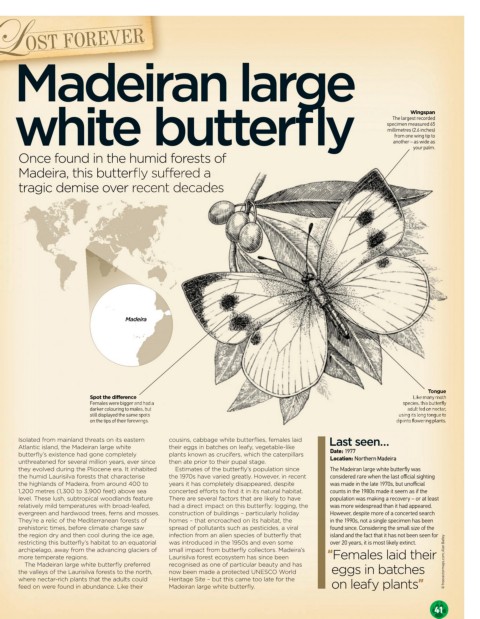
                                                                                                                     Wingspan
                                                                                                                The largest recorded
                                                                                                               millimetres (2.6 inches)
                                                                                                                from one wing tip to
                                                                                                                another – as wide as
                                                                                                                      your palm.
          Once found in the humid forests of
          Madeira, this butterfly suffered a
                                           y suffered a

          Madeira, this butterfl
          tragic demise over recent decades
          tragic demise over recent decades


                                       Madeira


                                                                                                                          Tongue
                                                                                                                          Tongue
                                                                                                                     Like many moth
                              Spot the difference
                              Spot the difference                                                                    Like many moth
                                                                                                                   species, this butterfl
                              Females were bigger and had a
                              Females were bigger and had a                                                        species, this butterfly

                                                                                                                               y
                              darker colouring to males, but
                                                                                                                    adult fed on nectar,
                              darker colouring to males, but                                                        adult fed on nectar,
                                                                                                                  using its long tongue to
                              still displayed the same spots
                              still displayed the same spots                                                      using its long tongue to
                              on the tips of their forewings.
                              on the tips of their forewings.                                                    dip into fl    owering plants.
                                                                                                                 dip into flowering plants.
          Isolated from mainland threats on its eastern   cousins, cabbage white butterflies, females laid   Last seen…

          Atlantic island, the Madeiran large white   their eggs in batches on leafy, vegetable-like

          butterfly’s existence had gone completely   plants known as crucifers, which the caterpillars   Date: 1977
          unthreatened for several million years, ever since   then ate prior to their pupal stage.    Location: Northern Madeira

          they evolved during the Pliocene era. It inhabited   Estimates of the butterfly’s population since   The Madeiran large white butterfly was

          the humid Laurisilva forests that characterise   the 1970s have varied greatly. However, in recent   considered rare when the last offi cial sighting

          the highlands of Madeira, from around 400 to   years it has completely disappeared, despite   was made in the late 1970s, but unoffi cial


          1,200 metres (1,300 to 3,900 feet) above sea   concerted efforts to find it in its natural habitat.   counts in the 1980s made it seem as if the
          level. These lush, subtropical woodlands feature   There are several factors that are likely to have   population was making a recovery – or at least
          relatively mild temperatures with broad-leafed,   had a direct impact on this butterfly: logging, the   was more widespread than it had appeared.

          evergreen and hardwood trees, ferns and mosses.   construction of buildings – particularly holiday   However, despite more of a concerted search
          They’re a relic of the Mediterranean forests of   homes – that encroached on its habitat, the   in the 1990s, not a single specimen has been
          prehistoric times, before climate change saw   spread of pollutants such as pesticides, a viral   found since. Considering the small size of the

          the region dry and then cool during the ice age,   infection from an alien species of butterfly that   island and the fact that it has not been seen for

          restricting this butterfly’s habitat to an equatorial   was introduced in the 1950s and even some   over 20 years, it is most likely extinct.
          archipelago, away from the advancing glaciers of   small impact from butterfly collectors. Madeira’s   “Females laid their

          more temperate regions.                  Laurisilva forest ecosystem has since been
            The Madeiran large white butterfly preferred   recognised as one of particular beauty and has                      © freevectormaps.com; Alan Batley

          the valleys of the Laurisilva forests to the north,   now been made a protected UNESCO World   eggs in batches
          where nectar-rich plants that the adults could   Heritage Site – but this came too late for the   on leafy plants”
          feed on were found in abundance. Like their   Madeiran large white butterfly.

                                                                                                                           41
   041_Lost Forever_Maderia Large White Butterfly.indd   41                                                              03/02/2016   16:21

