


Page 60 - World of Animals - Issue #30
P. 60
The dog that doesn’t bark


        Meet the super pack


        Dholes are strategic and cunning pack hunters

        Dholes are sociable animals, with an instinctive   Dholes are also less territorial than wolves, and there
        understanding of their place within a pack. The intricate   is little friction between packs; young members can join
        social structure of their groups makes them efficient   other packs without much of a struggle. Despite showing   DHOLE

        hunters, using the power of teamwork to take down prey   little pack rivalry, dholes claim huge territories of up to 88   Cuon alpinus
        they could never catch alone.                  square kilometres (34 square miles). The social aspects   Class Mammalia
          Each pack has an alpha male and an alpha female,   of the dholes’ lives in groups are peaceful, but it’s the
        who are usually the only members to reproduce. The   way that they use their numbers during hunting that has
        rest of the group consists mainly of males, in varying   earned them a fearsome reputation.
        degrees of status, and a smaller number of females.   These pack hunters frequently break into smaller groups   Territory Central and eastern
        Despite this, dholes are less hierarchical than wolves,   during hunting. They know how to exhaust, corner, and   Asia
                                                                                                      Diet Rodents, hares, ungulates
        show little aggression to each other (though dominance   confuse their prey, and will often entrust a few members   Lifespan 8-12 years
        is expressed), and have been observed playing with   with the duty of distraction, while others sneak up from   Adult weight 15-20kg
        enthusiasm, displaying strong bonds and family   behind. During the chase, these fast and nimble canids will   (33-44lb)
                                                                                                      Conservation status
        relationships. Perhaps the most notable expression of their   slow down their prey by wounding them where it counts
        empathy is that they let their young feed off a kill first,   – eyes are gouged, genitals are ripped and hamstrings are

        rather than favouring the dominant members’ needs, as is   torn to bring them to a halt. The dholes’ ruthlessness does   ENDANGERED
        so often the case in the animal kingdom.       not stop there: they often eat their prey alive.

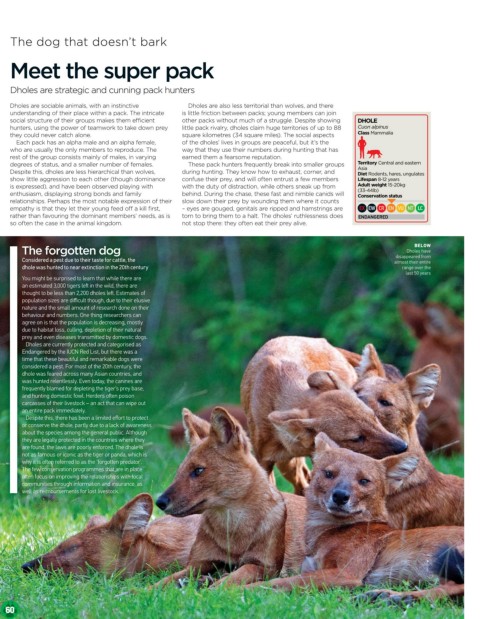
                                                                                                                      BELOW
           The forgotten dog                                                                                        Dholes have
                                                                                                                 disappeared from
           Considered a pest due to their taste for cattle, the                                                 almost their entire
           dhole was hunted to near extinction in the 20th century                                                range over the
                                                                                                                   last 50 years
           You might be surprised to learn that while there are

           an estimated 3,000 tigers le	 in the wild, there are
           thought to be less than 2,200 dholes le	. Estimates of

           population sizes are diffi cult though, due to their elusive

           nature and the small amount of research done on their
           behaviour and numbers. One thing researchers can
           agree on is that the population is decreasing, mostly
           due to habitat loss, culling, depletion of their natural
           prey and even diseases transmitted by domestic dogs.
            Dholes are currently protected and categorised as
           Endangered by the IUCN Red List, but there was a
           time that these beautiful and remarkable dogs were
           considered a pest. For most of the 20th century, the
           dhole was feared across many Asian countries, and
           was hunted relentlessly. Even today, the canines are
           frequently blamed for depleting the tiger’s prey base,
           and hunting domestic fowl. Herders o	en poison

           carcasses of their livestock – an act that can wipe out
           an entire pack immediately.

            Despite this, there has been a limited effort to protect
           or conserve the dhole, partly due to a lack of awareness
           about the species among the general public. Although
           they are legally protected in the countries where they
           are found, the laws are poorly enforced. The dhole is
           not as famous or iconic as the tiger or panda, which is
           why it is o	en referred to as the ‘forgotten predator’.

           The few conservation programmes that are in place
           o	en focus on improving the relationships with local

           communities through information and insurance, as
           well as reimbursements for lost livestock.


       60


   058-062_Dhole.indd   60                                                                                               03/02/2016   16:41

