


Page 26 - (DK Eyewitness) Travel Guide - Ireland
P. 26
24 INTRODUCING IRELAND
Architecture in Ireland
Ireland’s turbulent history has done incalculable damage to
its architectural heritage. Cromwell’s forces, in particular,
destroyed scores of castles, monasteries and towns in their
three-year campaign against the Irish in the mid-17th
century. However, many fascinating buildings and sites
remain, with Iron Age forts being the earliest surviving
settlements. Christianity in Ireland gave rise to mon asteries,
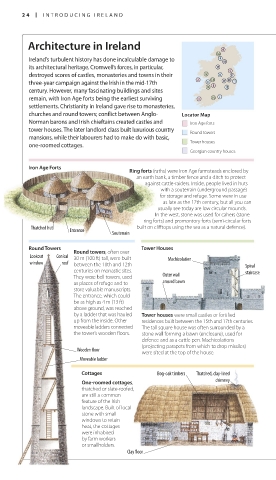
churches and round towers; conflict between Anglo- Locator Map
Norman barons and Irish chieftains created castles and Iron Age forts
tower houses. The later landlord class built luxurious country Round towers
mansions, while their labourers had to make do with basic, Tower houses
one-roomed cottages.
Georgian country houses
Iron Age Forts
Ring forts (raths) were Iron Age farmsteads enclosed by
an earth bank, a timber fence and a ditch to protect
against cattle-raiders. Inside, people lived in huts
with a souterrain (underground passage)
for storage and refuge. Some were in use
as late as the 17th century, but all you can
usually see today are low circular mounds.
In the west, stone was used for cahers (stone
ring forts) and promontory forts (semi-circular forts
Thatched hut Entrance built on clifftops using the sea as a natural defence).
Souterrain
Round Towers Round towers, often over Tower Houses
Lookout Conical 30 m (100 ft) tall, were built Machicolation
window roof between the 10th and 12th Spiral
centuries on monastic sites. staircase
They were bell towers, used Outer wall
as places of refuge and to around bawn
store valuable manuscripts.
The entrance, which could
be as high as 4 m (13 ft)
above ground, was reached
by a ladder that was hauled Tower houses were small castles or fortified
up from the inside. Other residences built between the 15th and 17th centuries.
moveable ladders connected The tall square house was often surrounded by a
the tower’s wooden floors. stone wall forming a bawn (enclosure), used for
defence and as a cattle pen. Machicolations
(projecting parapets from which to drop missiles)
Wooden floor were sited at the top of the house.
Moveable ladder
Cottages Bog-oak timbers Thatched, clay-lined
One-roomed cottages, chimney
thatched or slate-roofed,
are still a common
feature of the Irish
landscape. Built of local
stone with small
windows to retain
heat, the cottages
were inhabited
by farm workers
or smallholders.
Clay floor
024-025_EW_Ireland.indd 24 25/04/16 11:00 am

