


Page 38 - (DK Eyewitness) Travel Guide - Ireland
P. 38
36 INTRODUCING IRELAND
Prehistoric Ireland
Until about 9,500 years ago Ireland was uninhabited. The
first people, who may have crossed by a land bridge from
Scotland, were hunter-gatherers and left few traces of
permanent settlement. The 4th millennium BC saw the arrival
of Neolithic farmers and herdsmen who built stone field walls
and monumental tombs such as Newgrange. Metalworking
was brought from Europe around 2000 BC by the Bronze Age Ireland c. 8000 BC
Beaker people, who also introduced new pottery skills. The Former coastline
Iron Age reached Ireland in the 3rd century BC along with the Present-day coastline
Celts, who migrated from Central Europe, via France and Britain,
and soon established themselves as the dominant culture.
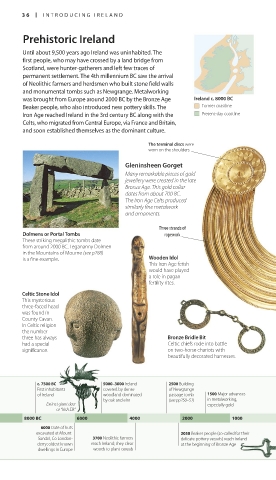
The terminal discs were
worn on the shoulders.
Gleninsheen Gorget
Many remarkable pieces of gold
jewellery were created in the late
Bronze Age. This gold collar
dates from about 700 BC.
The Iron Age Celts produced
similarly fine metalwork
and ornaments.
Three strands of
Dolmens or Portal Tombs ropework
These striking megalithic tombs date
from around 2000 BC. Legananny Dolmen
in the Mountains of Mourne (see p288)
is a fine example. Wooden Idol
This Iron Age fetish
would have played
a role in pagan
fertility rites.
Celtic Stone Idol
This mysterious
three-faced head
was found in
County Cavan.
In Celtic religion
the number
three has always Bronze Bridle Bit
had a special Celtic chiefs rode into battle
significance. on two-horse chariots with
beautifully decorated harnesses.
c. 7500 BC 5000–3000 Ireland 2500 Building
First inhabitants covered by dense of Newgrange
of Ireland woodland dominated passage tomb 1500 Major advances
by oak and elm (see pp250–51) in metalworking,
Extinct giant deer especially gold
or “Irish Elk”
8000 BC 6000 4000 2000 1000 750
6000 Date of huts
excavated at Mount- 2050 Beaker people (so-called for their
Sandel, Co London- 3700 Neolithic farmers delicate pottery vessels) reach Ireland
derry; oldest known reach Ireland; they clear at the beginning of Bronze Age
dwellings in Europe woods to plant cereals
036-037_EW_Ireland.indd 36 08/03/17 11:05 am
Eyewitness Travel LAYERS PRINTED:
Starsight history template “UK” LAYER
(Source v1)
Date 22nd October 2012
Size 125mm x 217mm

