


Page 39 - (DK Eyewitness) Travel Guide - Ireland
P. 39
THE HIST OR Y OF IRELAND 37
Palisade (fence) Thatched houses
Where to See
Prehistoric Ireland
Prehistoric sites range from
individual tombs such as
Newgrange, Brownshill
Dolmen (see p145) or Ossian’s
Grave to whole settlements,
as at Céide Fields (p208) and
Lough Gur (p198). The largest
Causeway to lake shore Stone Age cemetery is at
Carrowmore (p238). Good
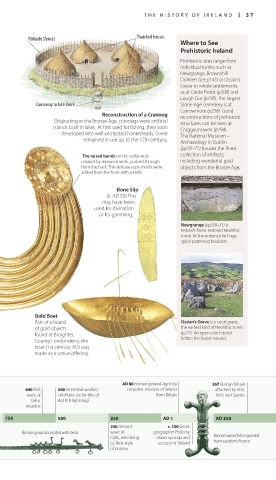
Reconstruction of a Crannog reconstructions of prehistoric
Originating in the Bronze Age, crannogs were artificial structures can be seen at
islands built in lakes. At first used for fishing, they soon Craggaunowen (p194).
developed into well-protected homesteads. Some The National Museum –
remained in use up to the 17th century. Archaeology in Dublin
(pp70–71) houses the finest
The raised bands on the collar were collection of artifacts,
created by repoussé work, pushed through including wonderful gold
from the back. The delicate rope motifs were objects from the Bronze Age.
added from the front with a knife.
Bone Slip
(c. AD 50) This
may have been
used for divination
or for gambling.
Newgrange (pp250–51) is
Ireland’s finest restored Neolithic
tomb. At the entrance lie huge
spiral-patterned boulders.
Gold Boat
Part of a hoard Ossian’s Grave is a court grave,
of gold objects the earliest kind of Neolithic tomb
found at Broighter, (p271). An open court stood
before the burial mound.
County London derry, the
boat (1st century AD) was
made as a votive offering.
AD 80 Roman general Agricola 367 Roman Britain
600 First 500 Intertribal warfare; considers invasion of Ireland attacked by Irish,
wave of chieftains vie for title of from Britain Picts and Saxons
Celtic Ard Ri (High King)
invaders
1000 750 500 250 AD 1 AD 250
250 Second c. 150 Greek
Bronze goad decorated with birds wave of geographer Ptolemy
Celts, who bring draws up map and Bronze sword hilt imported
La Tène style account of Ireland from southern France
of pottery
036-037_EW_Ireland.indd 37 08/03/17 11:05 am

