


Page 43 - (DK Eyewitness) Travel Guide - Ireland
P. 43
THE HIST OR Y OF IRELAND 41
Where to See Anglo-
Norman Ireland
The strength of Norman
fortifications is best seen in the
castles at Carrickfergus, Limerick
(see p195) and Trim (p252) and in
Waterford’s city walls. Gothic
cathedrals that survive include
Dublin’s Christ Church (pp84–5)
and St Patrick’s (pp86–7) and
Richard II’s Fleet Returning to England in 1399 St Canice’s (p148) in Kilkenny.
Richard made two trips to Ireland – in 1394 and 1399. On the first he There are impressive ruins of
defeated Art McMurrough, King of Leinster, and other Irish chiefs, but medieval Cistercian abbeys at
the second was inconclusive. Jerpoint and Boyle (p223).
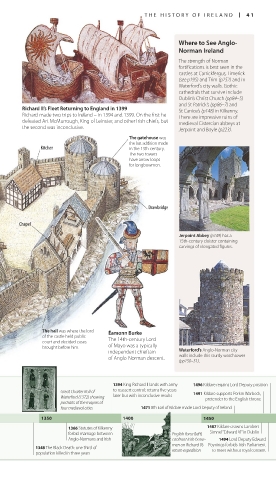
The gatehouse was
the last addition made
Kitchen in the 13th century.
The two towers
have arrow loops
for longbowmen.
Drawbridge
Chapel
Jerpoint Abbey (p149) has a
15th-century cloister containing
carv ings of elongated figures.
The hall was where the lord Éamonn Burke
of the castle held public
court and decided cases The 14th-century Lord
brought before him. of Mayo was a typically Waterford’s Anglo-Norman city
independent chieftain walls include this sturdy watchtower
of Anglo-Norman descent.
(pp150–51).
1394 King Richard II lands with army 1496 Kildare regains Lord Deputy position
Great Charter Roll of to reassert control; returns five years 1491 Kildare supports Perkin Warbeck,
Waterford (1372) showing later but with inconclusive results pretender to the English throne
portraits of the mayors of
four medieval cities 1471 8th Earl of Kildare made Lord Deputy of Ireland
1300 1350 1400 1450
1366 Statutes of Kilkenny 1487 Kildare crowns Lambert
forbid marriage between English force (left) Simnel “Edward VI” in Dublin
Anglo-Normans and Irish confront Irish horse 1494 Lord Deputy Edward
men on Richard II’s Poynings forbids Irish Parliament
1348 The Black Death: one third of return expedition to meet without royal consent
population killed in three years
040-041_EW_Ireland.indd 41 08/03/17 11:05 am

