


Page 82 - (DK Eyewitness) Travel Guide - Ireland
P. 82
80 DUBLIN AREA B Y AREA
1 Dublin Castle
For seven centuries Dublin Castle was the seat of English rule,
ever since the Anglo-Normans built a fortress here in the
13th century. All that remains of the original structure is the
southeastern tower, now called the Record Tower. Following
a fire in 1684, the Surveyor-General, Sir William Robinson, laid
down the plans for the Upper and Lower Castle Yards in their
present form. On the first floor of the south side of the Upper
Yard are the luxury State Apartments, including St Patrick’s Hall.
These magnificent rooms served as home to the British-
appointed Viceroys of Ireland.
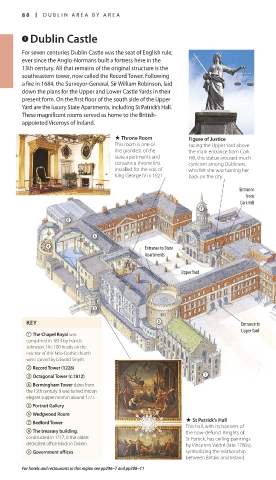
. Throne Room Figure of Justice
This room is one of Facing the Upper Yard above
the grandest of the the main entrance from Cork
state apartments and Hill, this statue aroused much
contains a throne first cynicism among Dubliners,
installed for the visit of who felt she was turning her
King George IV in 1821. back on the city.
Entrance
from
Cork Hill
Entrance to State
Apartments
Upper Yard
KEY Entrance to
Upper Yard
1 The Chapel Royal was
completed in 1814 by Francis
Johnston. The 100 heads on the
exterior of this Neo-Gothic church
were carved by Edward Smyth.
2 Record Tower (1226)
3 Octagonal Tower (c.1812)
4 Bermingham Tower dates from
the 13th century. It was turned into an
elegant supper room in around 1777.
5 Portrait Gallery
6 Wedgwood Room
. St Patrick’s Hall
7 Bedford Tower
This hall, with its banners of
8 The treasury building, the now-defunct Knights of
constructed in 1717, is the oldest St Patrick, has ceiling paintings
dedicated office block in Dublin. by Vincenzo Valdré (late 1780s),
9 Government offices symbolizing the relationship
between Britain and Ireland.
For hotels and restaurants in this region see pp296–7 and pp308–11
080-081_EW_Ireland.indd 80 08/03/17 11:05 am
Eyewitness Travel LAYERS PRINTED:
Catalogue template “UK” LAYER
(Source v2)
Date 14th November 2012
Size 125mm x 217mm

