


Page 46 - Forbes - Asia (April 2019)
P. 46
Japan’s 50 Richest


                     “WE DARED TO MAKE

                               THE          IMPOSSIBLE,

                        POSSIBLE.”


               One major technology behind the network is called a
           virtualized radio access network (vRAN), which simplifies
           base stations that connect handsets to the network. Using
           this and other know-how, Rakuten Chief Technology Officer
           Tareq Amin says its cloud-based network can slash operating
           and maintenance costs by at least 30%. Rakuten is building its
           4G service to easily convert to 5G, a change that he says can
           be done as a software upgrade, rather than through expensive
           new hardware outlays. 5G, which Rakuten plans to start in
           2020, promises real-time connectivity, including for AI servic-
           es and autonomous driving, and download speeds a hundred
           times faster than today through greater capacity—something
           especially crucial in Japan’s congested urban networks.
              Mikitani isn’t the first tycoon to shake up Japan’s telecom-
           munications industry. Billionaire Masayoshi Son made a
           similar bet. Rather than starting from scratch, as Mikitani is
           doing, Son entered by acquiring an existing carrier, Vodafone’s
           Japan operations, for nearly 1.8 trillion yen ($15 billion) in
           2006, which is now known as SoftBank Corp. Son thus set a
           precedent that a driven newcomer could become an estab-
           lished company in the sector, expanding its share to about
           26% from 16% over six years.
              While Rakuten is optimistic about being able to make its
           service work in time for its commercial launch in October,
           some investors remain skeptical—the company’s share price
           today hovers near where it was in December 2017 when it             February. CLSA forecasts Rakuten’s net profit will drop 59%
           first said it would go into telecom. “We feel it is too early       to 58.9 billion yen in 2019 and fall another 38% to 36.4 billion
           to be investing into a mobile network operator success, so          yen next year because of mobile capital outlays and separate
           we maintain our cautious view,” Oliver Matthew and Shinji           costs for improving its e-commerce logistics. The brokerage
           Yoshida, Tokyo-based analysts at CLSA, wrote in a report in         expects Rakuten’s mobile service to incur losses through at
                                                                               least the next three years.
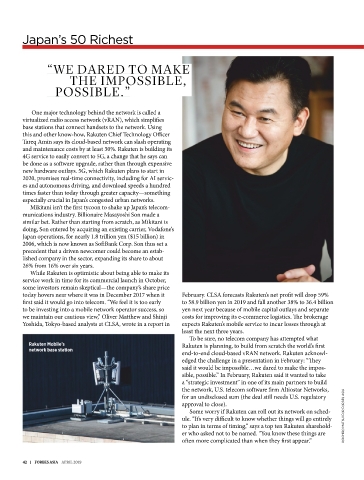
                                                                                   To be sure, no telecom company has attempted what
              Rakuten Mobile’s                                                 Rakuten is planning, to build from scratch the world’s first
              network base station
                                                                               end-to-end cloud-based vRAN network. Rakuten acknowl-
                                                                               edged the challenge in a presentation in February: “They
                                                                               said it would be impossible…we dared to make the impos-
                                                                               sible, possible.” In February, Rakuten said it wanted to take
                                                                               a “strategic investment” in one of its main partners to build
                                                                               the network, U.S. telecom software firm Altiostar Networks,
                                                                               for an undisclosed sum (the deal still needs U.S. regulatory
                                                                               approval to close).
                                                                                   Some worry if Rakuten can roll out its network on sched-
                                                                               ule. “It’s very difficult to know whether things will go entirely     KOICHIRO MATSUI FOR FORBES ASIA
                                                                               to plan in terms of timing,” says a top ten Rakuten sharehold-
                                                                               er who asked not to be named. “You know these things are
                                                                               often more complicated than when they first appear.”


           42     |     FORBES ASIA     APRIL 2019

