


Page 44 - Forbes - Asia (April 2019)
P. 44
Japan’s 50 Richest


                   R                  akuten CEO Hiroshi Mikitani doesn’t shy away from


                                      risks. His $5.5 billion bet is his biggest one to date: a
                                      startup using a new technology to disrupt the nation’s
                                      entrenched, three-way mobile phone oligopoly. Rakuten
                                      wants to build a new telecom network in Japan in as little
                                      as half the time and at a cost of up to 40% less than what
                             it would take to build a conventional system.
                                The new service, Rakuten Mobile, aims to attract about 10 mil-
                             lion customers over nine years—and 15 million over a longer
                             period—by providing what it claims will be a cheaper, faster and
                             more reliable network. That $5.5 billion capital outlay is roughly
                             the equivalent of what Japan’s two largest incumbent players, NTT
                             Docomo and KDDI, each spend in a single year. “Exactly. That is
                             the point,” says Mikitani, 54, who ranks No. 5 on this year’s list,
                             with a net worth of $6 billion.
                                Mikitani plans to leverage the 100 million customers in Japan
                             already using Rakuten’s e-commerce, credit cards, internet bank-
                             ing, online trading and content to also sign up for the mobile
                             service, which will start initially in October in major Japanese
                             cities and then expand nationwide. “Using our ecosystem, we can
                             acquire customers at a relatively lower cost,” Mikitani says. “Our
                             operation is much leaner than our competitors, and we can enrich
                             the service using the existing Rakuten ecosystem. And I don’t
                             think people really care whether it’s NTT, SoftBank or Rakuten
                             that much. It’s primarily about connectivity, speed, price and what
                             kind of extra services we can provide.”
                                While Rakuten’s initial public announcement to build the
                             network dates to December 2017, the first trial run of the service
                             wasn’t conducted until February, with Mikitani on hand to test it.
                             While Rakuten rolls out the service, KDDI will provide coverage
                             in areas where it’s not yet present, and the company already has a
                             virtual mobile service with lines leased from incumbent carriers
                             NTT Docomo and KDDI.
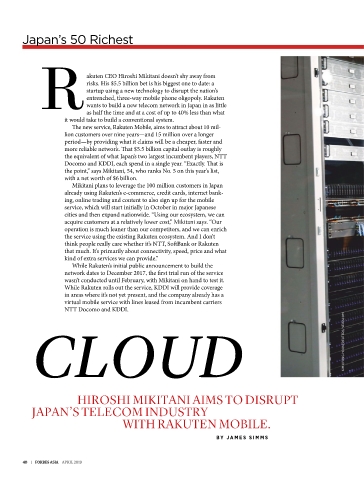
               CLOUD                                                                                                                                 KIM KYUNG HOON/REUTERS/NEWSCOM


                                  HIROSHI MIKITANI AIMS TO DISRUPT

               JAPAN’S TELECOM INDUSTRY

                                                      WITH           RAKUTEN                   MOBILE.


                                                                                              B Y   J A M E S   S I M M S


           40     |     FORBES ASIA     APRIL 2019

