


Page 47 - Forbes - Asia (April 2019)
P. 47
Yet others believe Rakuten’s mobile service will give it an
              edge over e-commerce rivals in Japan, especially Amazon.                   Rising Tones
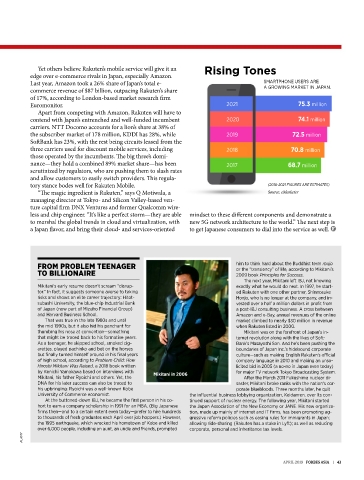
              Last year, Amazon took a 26% share of Japan’s total e-                                               SMARTPHONE USERS ARE
                                                                                                                   A GROWING MARKET IN JAPAN.
              commerce revenue of $87 billion, outpacing Rakuten’s share
              of 17%, according to London-based market research firm
              Euromonitor.                                                                         2021                             75.3 million
                 Apart from competing with Amazon, Rakuten will have to
              contend with Japan’s entrenched and well-funded incumbent                            2020                             74.1 million
              carriers. NTT Docomo accounts for a lion’s share at 38% of
              the subscriber market of 178 million, KDDI has 28%, while                            2019                         72.5 million
              SoftBank has 23%, with the rest being circuits leased from the
              three carriers used for discount mobile services, including                          2018                        70.8 million
              those operated by the incumbents. The big three’s domi-
              nance—they hold a combined 89% market share—has been                                 2017                      68.7 million
              scrutinized by regulators, who are pushing them to slash rates
              and allow customers to easily switch providers. This regula-
              tory stance bodes well for Rakuten Mobile.                                                             (2018-2021 FIGURES ARE ESTIMATES)
                 “The magic ingredient is Rakuten,” says Q Motiwala, a                                               Source: eMarketer
              managing director at Tokyo- and Silicon Valley-based ven-
              ture capital firm DNX Ventures and former Qualcomm wire-
              less and chip engineer. “It’s like a perfect storm—they are able     mindset to these different components and demonstrate a
              to marshal the global trends in cloud and virtualization, with       new 5G network architecture to the world.” The next step is
              a Japan flavor, and bring their cloud- and services-oriented         to get Japanese consumers to dial into the service as well.   F


                 FROM PROBLEM TEENAGER                                                                 him to think hard about the Buddhist term mujo
                 TO BILLIONAIRE                                                                        or the “transiency” of life, according to Mikitani’s
                                                                                                       2009 book Principles for Success.
                                                                                                          The next year, Mikitani left IBJ, not knowing
                 Mikitani’s early resume doesn’t scream “disrup-                                       exactly what he would do next. In 1997, he start-
                 tor.” In fact, it suggests someone averse to taking                                   ed Rakuten with one other partner, Shinnosuke
                 risks and shows an elite career trajectory: Hitot-                                    Honjo, who is no longer at the company, and in-
                 subashi University, the blue-chip Industrial Bank                                     vested over a half a million dollars in profit from
                 of Japan (now part of Mizuho Financial Group)                                         a post-IBJ consulting business. A cross between
                 and Harvard Business School.                                                          Amazon and e-Bay, annual revenues of the online
                     That was true in the late 1980s and until                                         market climbed to nearly $30 million in revenue
                 the mid 1990s, but it also hid his penchant for                                       when Rakuten listed in 2000.
                 thumbing his nose at convention—something                                                Mikitani was on the forefront of Japan’s in-
                 that might be traced back to his formative years.                                     ternet revolution along with the likes of Soft-
                 As a teenager, he skipped school, smoked cig-                                         Bank’s Masayoshi Son. And he’s been pushing the
                 arettes, played pachinko and bet on the horses                                        boundaries of Japan Inc.’s hidebound corporate
                 but finally turned himself around in his final years                                    culture—such as making English Rakuten’s official
                 of high school, according to Problem Child: How                                       company language in 2010 and making an unso-
                 Hiroshi Mikitani Was Raised, a 2018 book written                                      licited bid in 2005 (a no-no in Japan even today)
                 by Kenichi Yamakawa based on interviews with      Mikitani in 2006                    for major TV network Tokyo Broadcasting System.
                 Mikitani, his father Ryoichi and others. Yet, the                                        After the March 2011 Fukushima nuclear di-
                 DNA for his later success can also be traced to                                       saster, Mikitani broke ranks with the nation’s cor-
                 his upbringing: Ryoichi was a well-known Kobe                                         porate bluebloods. Three months later, he quit
                 University of Commerce economist.                                 the influential business lobbying organization, Keidanren, over its con-
                     At the buttoned-down IBJ, he became the first person in his co-  tinued support of nuclear energy. The following year, Mikitani started
                 hort to earn a company scholarship in 1991 for an MBA. (Big Japanese   the Japan Association of the New Economy or JANE. His new organiza-
                 firms then—and to a certain extent even today—prefer to hire hundreds   tion, made up mainly of internet and IT firms, has been promoting ag-
                 to thousands of fresh graduates each April over job hoppers.) However,   gressive reform policies such as easing rules for immigrants in Japan;
                 the 1995 earthquake, which wrecked his hometown of Kobe and killed   allowing ride-sharing (Rakuten has a stake in Lyft); as well as reducing
                 over 6,000 people, including an aunt, an uncle and friends, prompted   corporate, personal and inheritance tax levels.
           ALAMY


                                                                                                                           APRIL 2019    FORBES ASIA     |     43

