


Page 10 - Today's Dietitian (March 2020)
P. 10
Ancient Grains     By Densie Webb, PhD, RD


                                                                            an assistant professor of nutrition and
                                                                            dietetics and director of the didactic
                                                                            program in dietetics at Saint Louis Uni-
                                                                            versity.  Compare that, she says, with
                                                                                  2
                                                                            Africa, India, and China, where sorghum
                                                                            is a dietary staple.

                                                                            Sorghum Nutrition
                                                                            Sorghum, also known as milo, is a
                                                                                                  3
                                                                            member of the grass family.  The grains
                                                                            can vary in color, from white or red
                                                                            to golden-brown or purple. Sorghum
                                                                            seeds have an edible hull. The whole
                                                                            grain is a good source of protein (5 g)
                                                                            and an excellent source of fiber (8 g) per
                                                                            1/4-cup serving.   4
                                                                              “Sorghum is also rich in phytochemi-
                                                                            cals, including anthocyanins, flavones,
                                                                            tannins, and phenols,” says Caroline
                                                                            Sluyter, MS, program director of the
                                                                            Oldways Whole Grains Council. Most
                                                                            of the phytochemicals are concen-
                                                                            trated in the bran fraction.  Because the
                                                                                                 5
                                                                            outer hull remains, even processed (eg,
                                                                            cracked, crushed, rolled, extruded, or
                                                                            cooked) sorghum should provide a bal-
                                                                            ance of nutrients similar to that found
                                                                            in the original grain seed. The excep-
                                                                            tion is pearled sorghum, in which the
                                                                            bran and some of the germ is removed to
                                                                            create a softer product. 2
                                                                              Sorghum syrup is a sweetener made
                                                                            by evaporating the water from the
                                                                            extracted juice of sweet sorghum stalks.
                                                                                                           6
                                                                            There are several varieties of sorghum,
                                                                            some sweeter than others. Sorghum
        Sorghum                                                             syrup provides a bit of calcium, potas-
                                                                            sium, magnesium, and iron. While sim-
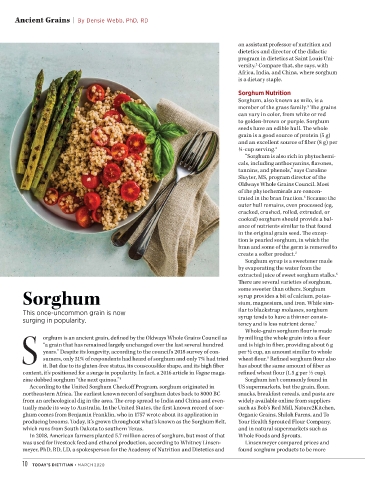
        This once-uncommon grain is now                                     ilar to blackstrap molasses, sorghum
        surging in popularity.                                              syrup tends to have a thinner consis-
                                                                            tency and is less nutrient dense. 7
        S      orghum is an ancient grain, defined by the Oldways Whole Grains Council as   by milling the whole grain into a flour
                                                                              Whole-grain sorghum flour is made
               “a grain that has remained largely unchanged over the last several hundred
                                                                            and is high in fiber, providing about 6 g
               years.” Despite its longevity, according to the council’s 2018 survey of con-
                                                                            per 1/2 cup, an amount similar to whole
                                                                                     8
               sumers, only 31% of respondents had heard of sorghum and only 7% had tried
                                                                            has about the same amount of fiber as
               it. But due to its gluten-free status, its couscouslike shape, and its high fiber   wheat flour.  Refined sorghum flour also
        content, it’s positioned for a surge in popularity. In fact, a 2016 article in Vogue maga-  refined wheat flour (1.5 g per 1/2 cup).
        zine dubbed sorghum “the next quinoa.”   1                            Sorghum isn’t commonly found in
          According to the United Sorghum Checkoff Program, sorghum originated in   US supermarkets, but the grain, flour,
        northeastern Africa. The earliest known record of sorghum dates back to 8000 BC   snacks, breakfast cereals, and pasta are
        from an archeological dig in the area. The crop spread to India and China and even-  widely available online from suppliers
        tually made its way to Australia. In the United States, the first known record of sor-  such as Bob’s Red Mill, Nature2Kitchen,
        ghum comes from Benjamin Franklin, who in 1757 wrote about its application in   Organic Grains, Shiloh Farms, and To
        producing brooms. Today, it’s grown throughout what’s known as the Sorghum Belt,   Your Health Sprouted Flour Company,
        which runs from South Dakota to southern Texas.                     and in natural supermarkets such as
          In 2018, American farmers planted 5.7 million acres of sorghum, but most of that   Whole Foods and Sprouts.
        was used for livestock feed and ethanol production, according to Whitney Linsen-  Linsenmeyer compared prices and
        meyer, PhD, RD, LD, a spokesperson for the Academy of Nutrition and Dietetics and   found sorghum products to be more

        10 TODAY’S DIETITIAN • MARCH 2020

