


Page 10 - BBC Wildlife Volume 36 #11
P. 10
WILDNOVEMBER

                                                                                                                                             ON RADIO
                                                                                                                                             TWEET OF

             5 | JUNIPER                                                                                                                      THE DAY
                                                                                                                                             Weekdays at 05.58
             Merry berry

             The current craze for artisan gin has,
             ironically, coincided with a decline in the
             wild plant whose ‘berries’ (actually fleshy
             cones) provide the flavour. Juniper is
             among the most ancient trees in the British
             Isles, having colonised quickly after the
             end of the last ice age. It is one of just three
             native British conifers, the others being yew
             and Scots pine. In recent decades, juniper
             has fallen victim of overgrazing by sheep,
             deer and rabbits, which strip out seedlings.
             Conservation projects are underway in its
             two strongholds: uplands in the north, and
             chalk downs in the south.                         6 | REDWING
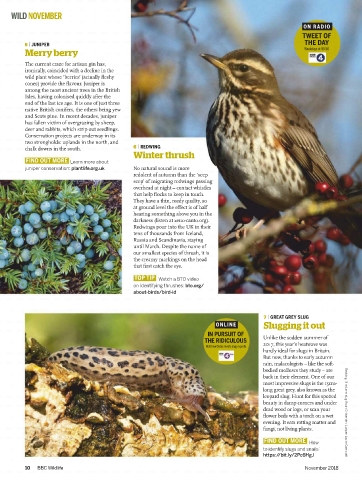
                                                               Winter thrush
             FIND OUT MORE Learn more about
             juniper conservation: plantlife.org.uk            No natural sound is more
                                                               redolent of autumn than the ‘seep
                                                               seep’ of migrating redwings passing
                                                               overhead at night – contact whistles
                                                               that help flocks to keep in touch.
                                                               They have a thin, reedy quality, so
                                                               at ground level the effect is of half
                                                               hearing something above you in the
                                                               darkness (listen at xeno-canto.org).
                                                               Redwings pour into the UK in their
                                                               tens of thousands from Iceland,
                                                               Russia and Scandinavia, staying
                                                               until March. Despite the name of
                                                               our smallest species of thrush, it is
                                                               the creamy markings on the head
                                                               that first catch the eye.


                                                               TOP TIP Watch a BTO video
                                                               on identifying thrushes: bto.org/
                                                               about-birds/bird-id


                                                                                                                           7 | GREAT GREY SLUG
                                                                                                     ONLINE                Slugging it out

                                                                                                 IN PURSUIT OF
                                                                                               THE RIDICULOUS             Unlike the sodden summer of
                                                                                                Matthew Oates meets slug experts  2017, this year’s heatwave was
                                                                                                                          hardly ideal for slugs in Britain.
                                                                                                                          But now, thanks to early autumn
                                                                                                                          rain, malacologists – like the soft-
                                                                                                                          bodied molluscs they study – are
                                                                                                                          back in their element. One of our
                                                                                                                          most impressive slugs is the 15cm-
                                                                                                                          long great grey, also known as the
                                                                                                                          leopard slug. Hunt for this spotted
                                                                                                                          beauty in damp corners and under
                                                                                                                          dead wood or logs, or scan your
                                                                                                                          flower beds with a torch on a wet      Redwing: Mike Lane; slug: Robin Chittenden; Juniper: Laurie Campbell
                                                                                                                          evening. It eats rotting matter and
                                                                                                                          fungi, not living plants.

                                                                                                                           FIND OUT MORE        How
                                                                                                                          to identify slugs and snails:
                                                                                                                          https://bit.ly/2Pc6HgJ


             10   BBC Wildlife                                                                                                                November 2018

