


Page 8 - BBC Wildlife Volume 36 #11
P. 8
WILDNOVEMBER


                                                                                                                      2 | YELLOW-NECKED MOUSE
                                                                                                                      Mystery rodent


                                                                                                                      Few, even wildlife lovers, have heard
                                                                                                                      of this wood mouse lookalike. Apart
                                                                                                                      from its band of tawny chest fur, seen
                                                                                                                      clearly only at very close range, the
                                                                                                                      species resembles its more-common
                                                                                                                      relative, but its range and behaviour
                                                                                                                      are somewhat different. Yellow-necked
                                                                                                                      mice occur patchily in southern
                                                                                                                      England and Wales, north through
                                                                                                                      the Welsh Borders to Staffordshire.
                                                                                                                      They’re also more arboreal than wood
                                                                                                                      mice, spending much time foraging
                                                                                                                      in hedges and trees. At this time of
                                                                                                                      year you might hear them scampering
                                                                                                                      around their nests in lofts and sheds.


                                                                                                                       GET INVOLVED Download the
                                                                                                                      Mammal Mapper app: mammal.org.uk


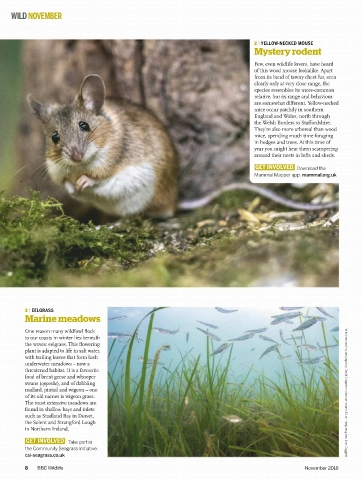
             3 | EELGRASS

             Marine meadows


             One reason many wildfowl flock
             to our coasts in winter lies beneath
             the waves: eelgrass. This flowering
             plant is adapted to life in salt water,
             with trailing leaves that form lush
             underwater meadows – now a
             threatened habitat. It is a favourite
             food of brent geese and whooper
             swans (opposite), and of dabbling
             mallard, pintail and wigeon – one                                                                                                                  Y ellow-necked mouse (captive): David Chapman; whooper swans: Elliott Neep; eelgrass: Matt Doggett
             of its old names is wigeon grass.
             The most extensive meadows are
             found in shallow bays and inlets
             such as Studland Bay in Dorset,
             the Solent and Strangford Lough
             in Northern Ireland.


             GET INVOLVED Take part in
             the Community Seagrass Initiative:
             csi-seagrass.co.uk


             8    BBC Wildlife                                                                                                                November 2018

