


Page 101 - BBC Wildlife Volume 36 #11
P. 101
OURWILDWORLD


                                                             Q&A
               We solve your
               ba ing wildlife
               mysteries.


               More amazing facts at
               discoverwildlife.com


             This month’s panel


              STUART BLACKMAN  LAURIE JACKSON  LIZ KALAUGHER    MIKE TOMS    CHRISTINA HARRISON  RICHARD JONES  ROBERTO ISOTTI  SARAH McPHERSON
                 Science writer  Wildlife tour leader   Author of Furry Logic  BTO  Royal Botanic Gardens, Kew  Entomologist  Photographer and naturalist  Q&A editor


                REPTILES
                How did the leatherback


                turtle get its name?


                     Reaching half a tonne in weight, the leatherback
                Aturtle is a giant among reptiles – only a few
                species of crocodilian are larger. It is also remarkable
                for lacking the bony carapace typical of its relatives.
                Its ‘shell’ is in fact a layer of tough, rubbery skin
                adorned with thousands of tiny bone plates.
                Its scientific name, Dermochelys coriacea,
                translates as ‘leathery-skinned turtle’.
                Alternative colloquial names include ‘lute
                turtle’, which may derive from the seven
                ridges along its back, said to evoke the
                strings of a lute.
                  Leatherbacks are also unusual in being
                specialist predators of jellyfish. Fleshy,
                backward-pointing projections in the
                mouth and throat help them to handle
                and swallow their slippery
                prey. Stuart Blackman


         Aurélien Brusini/Hemis/Alamy                                                                                     individual was monitored swimming
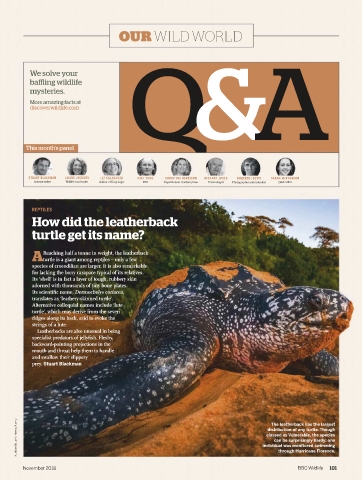
                                                                                                                              The leatherback has the largest
                                                                                                                            distribution of any turtle. Though
                                                                                                                            classed as Vulnerable, the species
                                                                                                                               can be surprisingly hardy: one

                                                                                                                                 through Hurricane Florence.


            November 2018                                                                                                                 BBC Wildlife   101

