


Page 102 - BBC Wildlife Volume 36 #11
P. 102
OURWILD WORLD
BOTANY
Doplantsuse
camoulage?
Plants usually provide the
Abackground against which animals
camouflage themselves. But there is
a handful of examples that buck the
trend. Perhaps the best known are the
pebble plants, a group of succulents
from southern Africa with bulbous,
fleshy leaves that mimic stones (known
as masquerade camouflage). Others,
such as the seedlings of some campions,
accumulate sand or soil on sticky leaves.
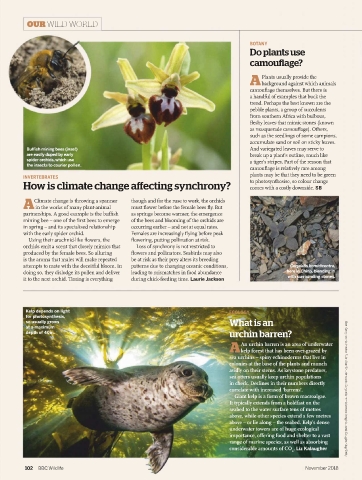
Bu sh mining bees (inset) And variegated leaves may serve to
are easily duped by early break up a plant’s outline, much like
spider orchids, which use a tiger’s stripes. Part of the reason that
the insects to courier pollen.
camouflage is relatively rare among
INVERTEBRATES plants may be that they need to be green
to photosynthesise, so colour change
How is climate change afecting synchrony? comes with a costly downside. SB
Climate change is throwing a spanner though and for the ruse to work, the orchids
A in the works of many plant-animal must flower before the female bees fly. But
partnerships. A good example is the buffish as springs become warmer, the emergence
mining bee – one of the first bees to emerge of the bees and blooming of the orchids are
in spring – and its specialised relationship occurring earlier – and not at equal rates.
with the early spider orchid. Females are increasingly flying before peak
Using their arachnid-like flowers, the flowering, putting pollination at risk.
orchids emit a scent that closely mimics that Loss of synchrony is not restricted to
produced by the female bees. So alluring flowers and pollinators. Seabirds may also
is the aroma that males will make repeated be at risk as their prey alters its breeding
attempts to mate with the deceitful bloom. In patterns due to changing oceanic conditions, Corydalis hemidicentra,
doing so, they dislodge its pollen and deliver leading to mismatches in food abundance here in China, blending in
with surrounding stones.
it to the next orchid. Timing is everything during chick-feeding time. Laurie Jackson
Kelp depends on light ECOLOGY
for photosynthesis,
so usually grows What is an
at a maximum
depth of 40m. urchin barren?
An urchin barren is an area of underwater
Akelp forest that has been over-grazed by
sea urchins – spiny echinoderms that live in
colonies at the base of the plants and munch
avidly on their stems. As keystone predators,
sea otters usually keep urchin populations
in check. Declines in their numbers directly
correlate with increased ‘barrens’. Bee: Getty; orchid: Hector Ruiz Villar/Shutterstock; Corydalis hemidicentra: Yang Niu; seal: Douglas Klug/Getty
Giant kelp is a form of brown macroalgae.
It typically extends from a holdfast on the
seabed to the water surface tens of metres
above, while other species extend a few metres
above – or lie along – the seabed. Kelp’s dense
underwater towers are of huge ecological
importance, offering food and shelter to a vast
range of marine species, as well as absorbing
considerable amounts of CO . Liz Kalaugher
2
102 BBC Wildlife November 2018

