


Page 53 - BBC Wildlife Volume 36 #11
P. 53
WILDNEWS


                  SEABIRDS
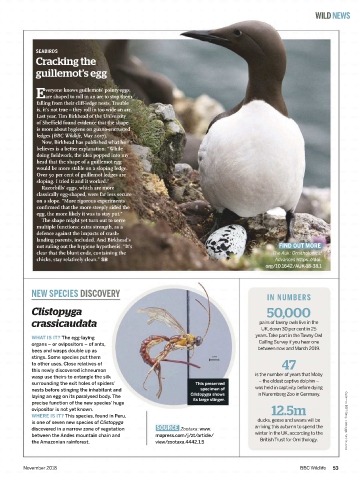
                  Cracking the


                  guillemot’s egg


                      veryone knows guillemots’ pointy eggs
                  Eare shaped to roll in an arc to stop them
                  falling from their cliff-ledge nests. Trouble
                  is, it’s not true – they roll in too wide an arc.
                  Last year, Tim Birkhead of the University
                  of Sheffield found evidence that the shape
                  is more about hygiene on guano-encrusted
                  ledges (BBC Wildlife, May 2017).
                    Now, Birkhead has published what he
                  believes is a better explanation: “While
                  doing fieldwork, the idea popped into my
                  head that the shape of a guillemot egg
                  would be more stable on a sloping ledge.
                  Over 50 per cent of guillemot ledges are
                  sloping. I tried it and it worked.”
                    Razorbills’ eggs, which are more
                  classically egg-shaped, were far less secure
                  on a slope. “More rigorous experiments
                  confirmed that the more steeply sided the
                  egg, the more likely it was to stay put.”
                    The shape might yet turn out to serve
                  multiple functions: extra strength, as a
                  defence against the impacts of crash-
                  landing parents, included. And Birkhead’s
                  not ruling out the hygiene hypothesis. “It’s                                                                    FIND OUT MORE
                  clear that the blunt ends, containing the                                                                    The Auk: Ornithological
                  chicks, stay relatively clean.” SB                                                                            Advances https://doi.
                                                                                                                            org/10.1642/AUK-18-38.1


                NEW SPECIES DISCOVERY                                                                                       IN NUMBERS


                Clistopyga                                                                                                  50,000


                crassicaudata                                                                                            pairs of tawny owls live in the
                                                                                                                          UK,down 30 per cent in 25
                                                                                                                       years.Take part in theTawny Owl
                WHAT IS IT? The egg-laying
                                                                                                                        Calling Survey if you hear one
                organs – or ovipositors – of ants,
                                                                                                                        between now and March 2019.
                bees and wasps double up as
                stings. Some species put them
                to other uses. Close relatives of                                                                                  47
                this newly discovered ichneumon
                                                                                                                       is the number of years that Moby
                wasp use theirs to entangle the silk
                                                                                                                        – the oldest captive dolphin –
                surrounding the exit holes of spiders’                                     This preserved
                nests before stinging the inhabitant and                                     specimen of               was held in captivity before dying
                                                                                         Clistopyga shows               in Nuremberg Zoo in Germany.
                laying an egg on its paralysed body. The
                                                                                          its large stinger.
                precise function of the new species’ huge
                ovipositor is not yet known.                                                                                  12.5m
                WHERE IS IT? This species, found in Peru,
                                                                                                                        ducks,geese and swans will be           Guillemot: BSIP/Getty; clistopyga: Kari Kaunisto
                is one of seven new species of Clistopyga
                                                                                                                       arriving this autumn to spend the
                discovered in a narrow zone of vegetation                SOURCE Zootaxa: www.
                                                                                                                       winter in the UK,according to the
                between the Andes mountain chain and                     mapress.com/j/zt/article/
                                                                                                                         British Trust for Ornithology.
                the Amazonian rainforest.                                view/zootaxa.4442.1.5


            November 2018                                                                                                                  BBC Wildlife    53

