


Page 51 - BBC Wildlife Volume 36 #11
P. 51
WILD NEWS


               CONSERVATION REPORT                                                         RED LIST

                                                                                            STATUS

               Greenturtle                                                               ENDANGERED


               This month, the conservation spotlight

               falls on a megaherbivore and its diet.


                Where does it live?                           native seagrasses, the turtles are giving
                The Green Turtle (Chelonia mydas) is a        Halophila a competitive edge and helping
                sea turtle that lives in the waters of the    it spread to new areas. The invasion is
                                                                                                                 Atlantic salmon are
                Caribbean. Its name comes from the            happening faster in grazed regions.
                                                                                                                 starting to return to
                colour of its body fat, resulting from the                                                       the Elan River.
                adults’ diet of seagrass and algae.           Can it be stopped?
                                                              Halophila is mainly a problem in tropical        RIVER ECOLOGY
                What’s the problem?                           waters. In the Mediterranean, it cannot
                A seagrass from the Red Sea, introduced       compete with the native seagrasses               Gravel aids
                to the eastern Caribbean in 2002, has         adapted to cooler conditions. We can’t
                already spread halfway across the region.     do much to stop it spreading. But we             river recovery
                Halophila stipulacea is replacing the native   can create conditions in which the
                seagrass, which provides food and shelter     native seagrasses flourish by addressing             n August, juvenile Atlantic salmon
                for many other organisms. Between 2011        local environmental problems such as             Iwere spotted in the Elan River in
                and 2017, Halophila spread from six to        pollution, dredging and water clarity.           mid-Wales for the first time in more
                20 per cent of our monitoring sites on                                                         than 40 years. It’s an important step
                Bonaire Island, while native seagrass         Can the turtles adapt?                           in the recovery of the river, which had
                declined by 33 per cent.                      The turtles may be able to switch diets          gradually been depleted of aquatic life
                                                              from seagrass to algae, although that’s          following the construction of the Elan
                Why is that bad news for turtles?             not straightforward because they carry a         Valley dams in 1904. Gravel has played
                Halophila is far less nutritious than the     specialist cast of gut microbes that help        a huge role in this turnaround.
                native seagrasses, and is largely ignored     them digest seagrass in particular. Our             The recent discovery comes in the
                by grazing green turtles. They’ll only eat it   concern is that this invasion is happening     wake of a three-year initiative by the
                if there’s nothing else available, and then   faster than they can adapt. S Blackman           Wye and Usk Foundation, along with
                they have to put more effort into grazing                                                      partners Dwr Cymru Welsh Water and
                to meet their nutritional needs. This leads   DR MARJOLIJN JA CHRISTIANEN                      Natural Resources Wales, to restore the
                to slower growth rates and delayed sexual     is assistant professor at Wageningen             ecology of 7km of this tributary of the
                maturity, which is significant in this slow-   University in the Netherlands.                   Wye, near the dams. These structures
                developing species.                                                                            had prevented riverbed gravel flowing
                                                              FIND OUT MORE  Journal of Ecology:               down to the lower Elan, while existing
                Turtlesaremakingmattersworse?                 https://besjournals.onlinelibrary.wiley.         sediment had been washed away,
                Yes. By preferentially grazing on the         com/doi/10.1111/1365-2745.13021                  leaving little habitat to support life.
                                                                                                                  Under the initiative, 2,300 tonnes of
                                                                                                               new gravel have been deposited in the
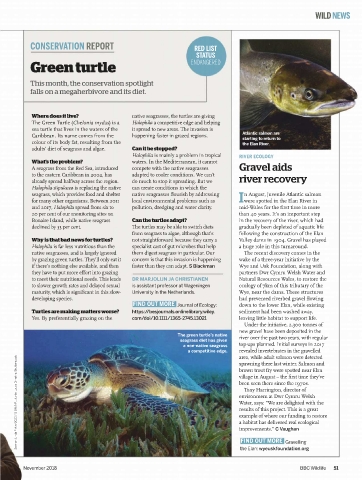
                                                                                   The green turtle’s native   river over the past two years, with regular
                                                                                    seagrass diet has given
                                                                                      a non-native seagrass    top-ups planned. Initial surveys in 2017
                                                                                        a competitive edge.    revealed invertebrates in the gravelled
                                                                                                               area, while adult salmon were detected
         Sa mon: L nda P tk n/2020VISION/NPL; turtle: Laura Dinraths/Shutterstock
                                                                                                               spawning there last winter. Salmon and
                                                                                                               brown trout fry were spotted near Elan
                                                                                                               village in August – the first time they’ve
                                                                                                               been seen there since the 1970s.
                                                                                                                  Tony Harrington, director of
                                                                                                               environment at Dwr Cymru Welsh
                                                                                                               Water, says: “We are delighted with the
                                                                                                               results of this project. This is a great
                                                                                                               example of where our funding to restore
                                                                                                               a habitat has delivered real ecological
                                                                                                               improvements.” C Vaughan


                                                                                                                FIND OUT MORE  Gravelling
                                                                                                                the Elan: wyeuskfoundation.org


            November 2018                                                                                                                  BBC Wildlife    51

