


Page 55 - BBC Wildlife Volume 36 #11
P. 55
WILDNEWS


                                               MEET THE SCIENTIST


                                               WilliamReid


                                               Marine biologist, Newcastle University, UK


                Biologist William Reid is
                researching the creatures
                that live in the deep seas

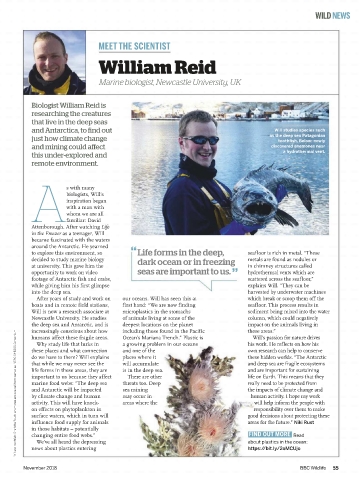
                and Antarctica, to ind out                                                                                      Will studies species such
                                                                                                                             as the deep sea Patagonian
                just how climate change                                                                                          toothfish. Below: newly

                and mining could afect                                                                                        discovered anemones near
                                                                                                                                    a hydrothermal vent.
                this under-explored and
                remote environment.


                                s with many
                                biologists, Will’s
                                inspiration began
                                with a man with
                                whom we are all
               Afamiliar: David
                Attenborough. After watching Life
                in the Freezer as a teenager, Will
                became fascinated with the waters
                around the Antarctic. He yearned
                to explore this environment, so              S  Life forms in the deep,                            seafloor is rich in metal. “These
                decided to study marine biology                 dark ocean or in freezing                          metals are found as nodules or
                at university. This gave him the                                                                   in chimney structures called
                opportunity to work on video                    seas are important to us.                   T      hydrothermal vents which are
                footage of Antarctic fish and crabs,                                                               scattered across the seafloor,”
                while giving him his first glimpse                                                                 explains Will. “They can be
                into the deep sea.                                                                                 harvested by underwater machines
                  After years of study and work on        our oceans. Will has seen this at                        which break or scoop them off the
                boats and in remote field stations,       first hand: “We are now finding                          seafloor. This process results in
                Will is now a research associate at       microplastics in the stomachs                            sediment being mixed into the water
                Newcastle University. He studies          of animals living at some of the                         column, which could negatively
                the deep sea and Antarctic, and is        deepest locations on the planet                          impact on the animals living in
                increasingly conscious about how          including those found in the Pacific                     these areas.”
        Will and toothfish: Charlotte Routh; anemones and scalpelliform barnacles: NERC CHESSO Consortium
                humans affect these fragile areas.        Ocean’s Mariana Trench.” Plastic is                         Will’s passion for nature drives
                  Why study life that lurks in            a growing problem in our oceans                          his work. He reflects on how his
                these places and what connection          and one of the                                           own research can help to conserve
                do we have to them? Will explains         places where it                                          these hidden worlds. “The Antarctic
                that while we may never see the           will accumulate                                          and deep sea are fragile ecosystems
                life forms in these areas, they are       is in the deep sea.                                      and are important for sustaining
                important to us because they affect         There are other                                        life on Earth. This means that they
                marine food webs: “The deep sea           threats too. Deep                                        really need to be protected from
                and Antarctic will be impacted            sea mining                                               the impacts of climate change and
                by climate change and human               may occur in                                               human activity. I hope my work
                activity. This will have knock-           areas where the                                             will help inform the people with
                on effects on phytoplankton in                                                                        responsibility over them to make
                surface waters, which in turn will                                                                 good decisions about protecting these
                influence food supply for animals                                                                  areas for the future.” Niki Rust
                in those habitats – potentially
                changing entire food webs.”                                                                         FIND OUT MORE Read
                  We’ve all heard the depressing                                                                   about plastics in the ocean:
                news about plastics entering                                                                       https://bit.ly/2oMCUjo


            November 2018                                                                                                                  BBC Wildlife    55

