


Page 70 - BBC Wildlife Volume 36 #11
P. 70
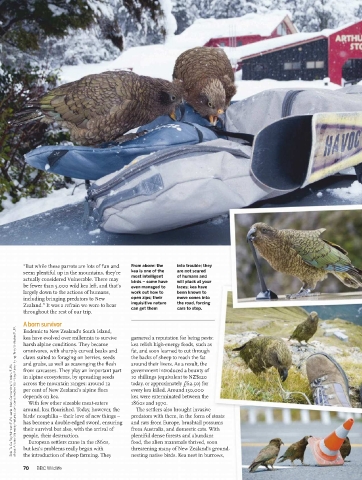
“But while these parrots are lots of fun and      From above: the      into trouble; they
            seem plentiful up in the mountains, they’re       kea is one of the    are not scared
                                                              most intelligent     of humans and
            actually considered Vulnerable. There may
                                                              birds – some have    will pluck at your
            be fewer than 5,000 wild kea left, and that’s     even managed to      laces; kea have
            largely down to the actions of humans,            work out how to      been known to
            including bringing predators to New               open zips; their     move cones into
                                                              inquisitive nature   the road, forcing
            Zealand.” It was a refrain we were to hear
                                                              can get them         cars to stop.
            throughout the rest of our trip.
            A born survivor
        shoes: Andrew Wa ms ey/naturep .com; cone: Andrew Wa ms ey/A amy; fly ng: Terry Wh ttaker/FLPA
            Endemic to New Zealand’s South Island,
            kea have evolved over millennia to survive        garnered a reputation for being pests:
            harsh alpine conditions. They became              kea relish high-energy foods, such as
            omnivores, with sharply curved beaks and          fat, and soon learned to cut through
            claws suited to foraging on berries, seeds        the backs of sheep to reach the fat
            and grubs, as well as scavenging the flesh         around their livers. As a result, the
       Skis: T ui De Roy/Minden/FLPA; aerial: Mark Carwardine/Minden /FLPA;
            from carcasses. They play an important part       government introduced a bounty of
            in alpine ecosystems, by spreading seeds          10 shillings (equivalent to NZ$120
            across the mountain ranges: around 12             today, or approximately £62.50) for
            per cent of New Zealand’s alpine flora             every kea killed. Around 150,000
            depends on kea.                                   kea were exterminated between the
              With few other sizeable meat-eaters             1860s and 1970.
            around, kea flourished. Today, however, the          The settlers also brought invasive
            birds’ neophilia – their love of new things –     predators with them, in the form of stoats
            has become a double-edged sword, ensuring         and rats from Europe, brushtail possums
            their survival but also, with the arrival of      from Australia, and domestic cats. With
            people, their destruction.                        plentiful dense forests and abundant
              European settlers came in the 1860s,            food, the alien mammals thrived, soon
            but kea’s problems really began with              threatening many of New Zealand’s ground-
            the introduction of sheep farming. They           nesting native birds. Kea nest in burrows,


            70    BBC Wildlife

