


Page 65 - BBC Wildlife Volume 36 #11
P. 65
VIEWPOINT


                                                                     MY   WAY    OF   THINKING


                          MARK                                  CARWARDINE


                    The broadcaster and campaigner airs his views on our perception of the state

                            of wildlife and wild places, and invites your thoughts on the subject.


                            ne of the greatest          hedgehogs I’ve seen all summer.                             there may be one or two. Or none. I
                            challenges in               And, in case you’re wondering, I’m                          also remember blizzard-like clouds of
                            conservation is tackling    not viewing my childhood through                            moths in the car headlights. But now
                            something called the        rose-tinted spectacles: the facts speak                     the air seems to be devoid of all life.
                            Shifting Baseline           for themselves.                                                Yet my norm is completely different
           OSyndrome. In essence,                          Over my lifetime, in the UK                              from my parents’ norm. I can’t begin
            it means that each generation has a         we have lost three-quarters of our                          to imagine how much wildlife was
            lower expectation of wildlife and wild      cuckoo population,                                          around in their day. There are still
            places than the previous generation.        three-quarters of          S  Thanks to a                   pockets of relative abundance (your
            What my generation sees as abundant         our butterflies have                                        chances of hearing a cuckoo are
            or pristine is seen by our parents          declined (some by             generational                  better in the Scottish Highlands, for
            as rare or degraded; and what we            as much as 96 per             blindness, we                 example) but, overall, the shocking,
            consider to be rare or degraded is          cent), and we have                                          rapid and calamitous decline in our
            seen as abundant or pristine by our         lost nearly 97 per cent       aren’t grasping               wildlife is there for all to see.
            children. We each assume that the           of all our hedgehogs          the severity of                  At least, it should be. Thanks
            current situation – the one we know         (there were 30 million                                      to this generational blindness to
            from first-hand experience – is the         when I was growing            the situation.          T     environmental destruction, we are
            norm. And so, over time, the                up – now there are                                          simply not grasping the severity of the
            ‘baseline’ shifts.                          one million). It’s a                                        situation. And that is the problem. The
              It’s a frightening concept: as a          wonder there is anything left at all.                       concept of a shifting baseline has been
            society we accept environmental                But perhaps the best example of                          around since 1995 – when it was first
            degradation, simply because we can’t        the Shifting Baseline Syndrome is the                       proposed by marine biologist Daniel
            imagine how the natural world used          so-called ‘windscreen test’. I remember                     Pauly – but we are only just waking up
            to be. What seems OK to us today            how, when I was a boy, long summer                          to what it really means.
            would have been considered pitiful a        car journeys would leave my father’s                           The solution is continuously to
            generation ago. Consequently, most          windscreen comprehensively splattered                       measure and record as much as we
            people don’t have a clue about how          with squashed moths, mosquitoes,                            possibly can – the UK’s State of Nature
            much wildlife we have lost.                 flies and other insects. Nowadays,                          report is a perfect example – to provide
              Even over my 59-year lifetime I can                                                                   a more accurate and tangible baseline.
            see the Shifting Baseline Syndrome                                                                      And then we have to shout about it
            in action. When I was a young boy,                                                                      from the rooftops.
            growing up in suburban Hampshire,                                                                          If we don’t, we will always be
            our garden was a veritable wildlife                                                                     satisfied with much too little, and we
            paradise. Cuckoos were the perpetual                                                                    will always aim far too low. Surely,
            soundtrack to summer, the flowerbeds                                                                    the severely depleted wildlife we are
            were alive with umpteen species of                                                                      becoming accustomed to in the UK
            butterflies, and four or five hedgehogs                                                                 should not be anyone’s norm?
            would come to be fed on our patio
            every night. I took it all for granted,                                                                 MARK CARWARDINE is a frustrated
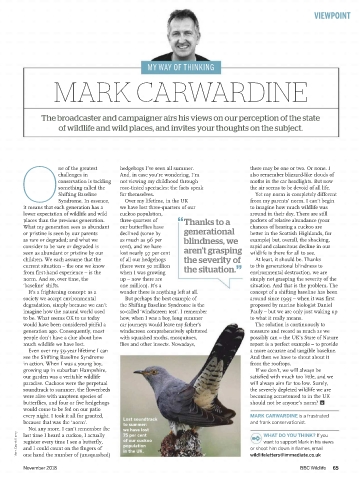
                                                          Lost soundtrack
            because that was the ‘norm’.                                                                            and frank conservationist.
                                                          to summer:
              Not any more. I can’t remember the          we have lost                                                     WHAT DO YOU THINK? If you
         Mark Caunt/Alamy  register every time I see a butterfly,  of our cuckoo                                    or shoot him down in flames, email
            last time I heard a cuckoo, I actually
                                                          75 per cent
                                                                                                                           want to support Mark in his views
                                                          population
            and I could count on the fingers of
                                                          in the UK.
            one hand the number of (unsquashed)
                                                                                                                    wildlifeletters@immediate.co.uk
            November 2018                                                                                                                  BBC Wildlife   65

