


Page 113 - (DK Eyewitness) Travel Guide - Italy
P. 113
VENICE 111
VISITORS’ CHECKLIST
Practical Information
Campo della Carità. Map 6 E3–E4.
Tel 041 520 03 45.
Open 8:15am–7:15pm daily
(to 2pm Mon, last adm: 1 hr
before closing). Closed 1 Jan,
1 May, 25 Dec. & 8 9 = ^
∑ gallerieaccademia.org
Transport
4 Accademia.
Room 8 and the rooms that
lead from it are largely devoted
to lighthearted landscape
and genre paintings from the
18th century. Among them are
pastoral scenes by Francesco
Zuccarelli, works by Marco Ricci,
scenes of Venetian society by
Healing of the Madman (c.1496) by Vittore Carpaccio Pietro Longhi and a view of
Venice by Canaletto (1763).
of St Mark Freeing a Slave (1548) This is a fine example of his
Byzantine and is also on display here. The sense of perspective.
International Gothic Sala dell’Albergo (room 24)
Room 1 shows the influence contains Titian’s magnificent Ceremonial Painting
of Byzantine art on the early Presentation of the Virgin
Venetian painters. In Paolo (1534–38), which was painted Rooms 20 and 21 return to
Veneziano’s glowing Coronation specifically for this space. the Renaissance, featuring
of the Virgin (1325), the linear two great cycles of paintings
rhythms are unmistakably from the late 16th century.
Gothic, but the gold back Baroque, Genre and The detail in these large
Landscape
ground and central panel scale anecdotal canvases
are distinctly Byzantine. Venice lacked native Baroque provides a fascinating glimpse
painters, but a few non of the life, customs and
Venetians kept the Venetian appearance of Venice at
Renaissance school alive in the 17th century. the time.
The Renaissance came late The most notable was the Room 20 houses The Stories
to Venice, but by the second Genoese Bernardo Strozzi (1581– of the Cross by Venice’s leading
quarter of the 15th century 1644). The artist was a great artists. In room 21, minutely
it had transformed the city admirer of the work of Veronese, detailed Scenes from the
into a thriving art centre as can be seen in his Feast at the Legend of St Ursula (1490s)
rivalling Florence and Rome. House of Simon (1629) in room by Carpaccio mix reality and
Central to Venetian art in the 11. Giambattista Tiepolo, the imagination by linking episodes
15th century was the Sacra greatest Venetian painter of the from the life of the saint to the
Conversazione, in which the 18th century, is represented in settings and costumes of
Madonna is portrayed with room 2 on the ground floor. 15thcentury Venice.
various saints in a harmo
nious composition.
Giovanni Bellini’s altarpiece
for San Giobbe (c.1487) in
room 2 is one of the finest
examples of this subject.
In contrast, the High
Renaissance exuberance
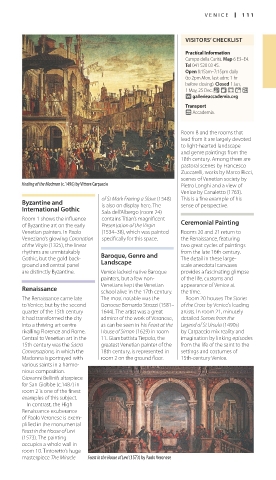
of Paolo Veronese is exem
plified in the monumental
Feast in the House of Levi
(1573). The painting
occupies a whole wall in
room 10. Tintoretto’s huge
masterpiece The Miracle Feast in the House of Levi (1573) by Paolo Veronese
110-111_EW_Italy.indd 111 4/4/17 5:32 PM

