


Page 190 - (DK Eyewitness) Travel Guide - Italy
P. 190
188 NOR THWEST IT AL Y
Understanding Architecture in Northwest Italy
Although the buildings of the northwest tend to be solid and imposing –
a result partly of the more severe climate – there is no distinctive
architectural stamp as there is around Venice, Florence or even in Rome.
Instead, a variety of buildings in different styles, many borrowed or
reinterpreted from elsewhere, are dotted across the area: enchanting
medieval castles, outstanding Romanesque and Gothic buildings,
unusual Baroque structures. The northwest is also rich in modern
architecture – in terms of both design and materials – influenced by the
region’s industrial developments and its strong flair for innovative design, Castello Sforzesco, 1451–66
which also often draws its inspiration from earlier architectural styles. (see p196)
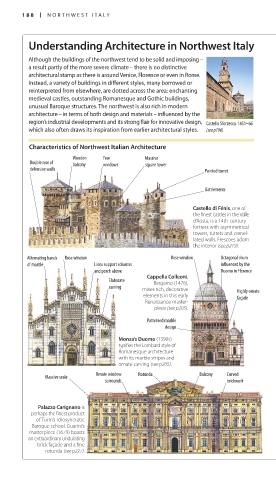
Characteristics of Northwest Italian Architecture
Wooden Few Massive
Double row of balcony windows square tower
defensive walls Pointed turret
Battlements
Castello di Fénis, one of
the finest castles in the Valle
d’Aosta, is a 14th-century
fortress with asymmetrical
towers, turrets and crenel-
lated walls. Frescoes adorn
the interior (see p219).
Alternating bands Rose window Rose window Octagonal drum
of marble Lions support columns influenced by the
and porch above Duomo in Florence
Cappella Colleoni,
Elaborate Bergamo (1476),
carving mixes rich, decorative Highly ornate
elements in this early façade
Renaissance master-
piece (see p205).
Patterned marble
design
Monza’s Duomo (1390s)
typifies the Lombard style of
Romanesque architecture
with its marble stripes and
ornate carving (see p205).
Massive scale Ornate window Rotunda Balcony Curved
surrounds brickwork
Palazzo Carignano is
perhaps the finest product
of Turin’s idiosyncratic
Baroque school. Guarini’s
masterpiece (1679) boasts
an extraordinary undulating
brick façade and a fine
rotunda (see p227).
188-189_EW_Italy.indd 188 26/04/16 5:15 pm
Eyewitness Travel LAYERS PRINTED:
Feature template “UK” LAYER
(SourceReport v1)
Date 24th July 2012
Size 125mm x 217mm

