


Page 191 - (DK Eyewitness) Travel Guide - Italy
P. 191
INTRODUCING NOR THWEST IT AL Y 189
Where to See the Architecture
The road to Aosta is flanked by numerous medieval
castles (see p218), while inspirational Romanesque and
Gothic churches are found in Lombardy – at Monza (p205),
Pavia (p207), Milan (pp196–205), and Como (pp194–5).
The 15th-century Certosa di Pavia (pp208–9) is a must, as
well as the charming city of Mantua (p211). Turin (pp224–9)
is famous for its unique Baroque school, and Bergamo for
its exuberance. Architecture from the last two centuries is
best represented in Milan and Turin, and in Genoa some Renzo Piano’s mast structure (1992) in Genoa’s
exciting redevelopment projects are taking place. redeveloped port and conference centre
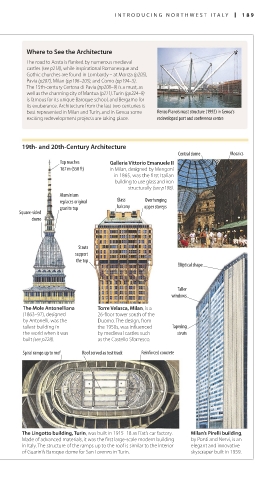
19th- and 20th-Century Architecture
Central dome Mosaics
Top reaches Galleria Vittorio Emanuele II
167 m (550 ft) in Milan, designed by Mengoni
in 1865, was the first Italian
building to use glass and iron
structurally (see p198).
Aluminium
replaces original Glass Overhanging
granite top balcony upper storeys
Square-sided
dome
Struts
support
the top
Elliptical shape
Taller
windows
The Mole Antonelliana Torre Velasca, Milan, is a
(1863–97), designed 26-floor tower south of the
by Antonelli, was the Duomo. The design, from
tallest building in the 1950s, was influenced Tapering
the world when it was by medieval castles such struts
built (see p228). as the Castello Sforzesco.
Spiral ramps up to roof Roof served as test track Reinforced concrete
The Lingotto building, Turin, was built in 1915–18 as Fiat’s car factory. Milan’s Pirelli building,
Made of advanced materials, it was the first large-scale modern building by Ponti and Nervi, is an
in Italy. The structure of the ramps up to the roof is similar to the interior elegant and innovative
of Guarini’s Baroque dome for San Lorenzo in Turin. skyscraper built in 1959.
188-189_EW_Italy.indd 189 26/04/16 5:15 pm

