


Page 207 - (DK Eyewitness) Travel Guide - Italy
P. 207
MILAN  І   205

       4 Monza                                 with a bas-relief of the Lion
                                               of Venice.
       Monza. * 120,000. V @ n Piazza
       Carducci 2 (039 32 32 22). Open 9am–      The arcades of the Palazzo
       noon, 3–6pm daily. ( Thu & Sat.         della Ragione lead to Piazza del
                                               Duomo, the square of the Neo-
       These days Monza is mostly              Classical Duomo. The square is
       famous for its international            dominated by the Cappella
       Formula One Autodromo, which            Colleoni (see p188), a chapel
       lies inside a vast park that also       built in 1476 to house the tomb
       has an elegant Rococo hunting           of Bergamo’s famous political
       lodge, the Villa Reale, and a golf      leader, Bartolomeo Colleoni.
       course. At one time, however,           It is flanked by two 14th-
       Monza was one of the most               century buildings: an octagonal
       important towns in Lombardy.            baptistry and the porch leading
       Theodolinda, the 6th-century            to the Romanesque basilica
       Lombard queen, built its first          of Santa Maria Maggiore.
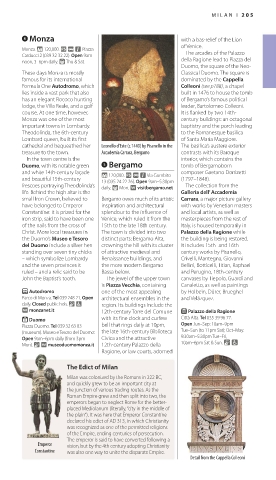
       cathedral and bequeathed her   Leonello d’Este (c.1440) by Pisanello in the   The basilica’s austere exterior
       treasure to the town.  Accademia Carrara, Bergamo  contrasts with its Baroque
         In the town centre is the             interior, which contains the
       Duomo, with its notable green   5 Bergamo  tomb of Bergamo born
       and white 14th-century façade   * 120,000. V @ n Via Gombito   composer Gaetano Donizetti
       and beautiful 15th-century   13 (035 24 22 26). Open 9am–5:30pm   (1797–1848).
       frescoes portraying Theodo linda’s   daily. ( Mon. ∑ visitbergamo.net    The collection from the
       life. Behind the high altar is the      Galleria dell’ Accademia
       small Iron Crown, believed to   Bergamo owes much of its artistic   Carrara, a major picture gallery
       have belonged to Emperor   inspiration and architectural   with works by Venetian masters
       Constantine: it is prized for the   splendour to the influence of   and local artists, as well as
       iron strip, said to have been one   Venice, which ruled it from the   masterpieces from the rest of
       of the nails from the cross of   15th to the late 18th century.   Italy, is housed temporarily in
       Christ. More local treasures in   The town is divided into two   Palazzo della Ragione while
       the Duomo’s Museo e Tesoro   distinct parts: Bergamo Alta,   the building is being restored.
       del Duomo include a silver hen   crowning the hill with its cluster   It includes 15th- and 16th-
       standing over seven tiny chicks   of attractive medieval and   century works by Pisanello,
       – which symbolize Lombardy   Renaissance buildings, and    Crivelli, Mantegna, Giovanni
       and the seven provinces it    the more modern Bergamo   Bellini, Botticelli, Titian, Raphael
       ruled – and a relic said to be   Bassa below.  and Perugino, 18th-century
       John the Baptist’s tooth.    The jewel of the upper town   canvases by Tiepolo, Guardi and
                           is Piazza Vecchia, containing   Canaletto, as well as paintings
       P Autodromo         one of the most appealing   by Holbein, Dürer, Brueghel
       Parco di Monza. Tel 039 248 21. Open   archi tectural ensembles in the   and Velázquez.
       daily. Closed public hols. & 7   region. Its buildings include the
       ∑ monzanet.it       12th-century Torre del Comune   E Palazzo della Ragione
       R Duomo             with its fine clock and curfew   Città Alta. Tel 035 39 96 77.
       Piazza Duomo. Tel 039 32 63 83   bell that rings daily at 10pm,    Open Jun–Sep: 10am–9pm
       (museum). Museo e Tesoro del Duomo:  the late 16th-century Biblioteca   Tue–Sun (to 11pm Sat); Oct–May:
       Open 9am–6pm daily (from 3pm   Civica and the attractive   9:30am– 5:30pm Tue–Fri,
       Mon). & ∑ museoduomomonza.it  12th-century Palazzo della   10am–6pm Sat & Sun. & 7
                           Ragione, or law courts, adorned
                  The Edict of Milan
                  Milan was colonized by the Romans in 222 BC,
                  and quickly grew to be an important city at
                  the junction of various trading routes. As the
                  Roman Empire grew and then split into two, the
                  emperors began to neglect Rome for the better-
                  placed Mediolanum (literally, “city in the middle of
                  the plain”). It was here that Emperor Constantine
                  declared his edict of AD 313, in which Christianity
                  was recognized as one of the permitted religions
                  of the Empire, ending centuries of persecution.
                  The emperor is said to have converted following a
           Emperor   vision, but by the 4th century adopting Christianity
          Constantine  was also one way to unite the disparate Empire.
                                                  Detail from the Cappella Colleoni


   204-205_EW_Italy.indd   205                                4/4/17   5:33 PM

