


Page 339 - (DK Eyewitness) Travel Guide - Italy
P. 339
TUSC AN Y 337
before it was even completed.
Today, the church’s eastern end
suffers from severe subsidence.
P Palazzo Piccolomini
Piazza Pio II. Tel 0577 28 63 00.
Open 10am–6:30pm Tue–Sun (to
4:30pm mid-Oct–mid-Mar). Closed
Jan– mid-Feb, mid–end Nov. & 8
p Montalcino
Siena. * 5,100. @ n Costa del
Municipio 1 (0577 84 93 31). ( Fri.
Hilltop Montalcino sits at
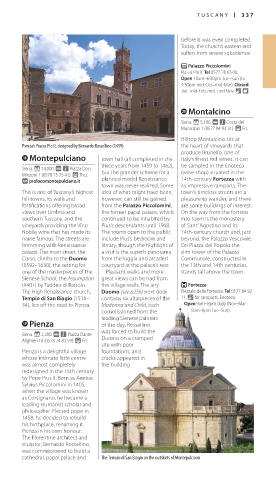
Pienza’s Piazza Pio II, designed by Bernardo Rossellino (1459) the heart of vineyards that
produce Brunello, one of
i Montepulciano town hall (all completed in the Italy’s finest red wines. It can
three years from 1459 to 1462), be sampled in the Enoteca
Siena. * 14,000. @ n Piazza Don
Minzoni 1 (0578 75 73 41). ( Thu. but the grander scheme for a (wine shop) situated in the
∑ prolocomontepulciano.it planned model Renaissance 14th-century Fortezza with
town was never realized. Some its impressive ramparts. The
This is one of Tuscany’s highest idea of what might have been, town’s timeless streets are a
hill-towns, its walls and however, can still be gained pleasure to wander, and there
fortifications offering broad from the Palazzo Piccolomini, are some buildings of interest.
views over Umbria and the former papal palace, which On the way from the fortress
southern Tuscany, and the continued to be inhabited by into town is the monastery
vineyards providing the Vino Pius’s descendants until 1968. of Sant’ Agostino and its
Nobile wine that has made its The rooms open to the public 14th-century church and, just
name famous. The streets are include Pius’s bedroom and beyond, the Palazzo Vescovile.
brimming with Renaissance library, though the highlight of On Piazza del Popolo the
palazzi. The main street, the a visit is the superb panorama slim tower of the Palazzo
Corso, climbs to the Duomo from the loggia and arcaded Communale, constructed in
(1592–1630), the setting for courtyard at the palace’s rear. the 13th and 14th centuries,
one of the masterpieces of the Pleasant walks and more stands tall above the town.
Sienese School, the Assumption great views can be had from
(1401) by Taddeo di Bartolo. the village walls. The airy + Fortezza
The High Renaissance church, Duomo (see p256) next door Piazzale della Fortezza. Tel 0577 84 92
Tempio di San Biagio (1518– contains six altarpieces of the 11. & for ramparts. Enoteca:
34), lies off the road to Pienza. Madonna and Child, each Open 9am–8pm daily (Nov–Mar:
commissioned from the 9am–6pm Tue–Sun).
leading Sienese painters
o Pienza of the day. Rossellino
was forced to build the
Siena. * 2,300. @ n Piazza Dante
Alighieri 18 (0578 74 83 59). ( Fri. Duomo on a cramped
site with poor
Pienza is a delightful village foundations, and
whose intimate little centre cracks appeared in
was almost completely the building
redesigned in the 15th century
by Pope Pius II. Born as Aeneas
Sylvius Piccolomini in 1405,
when the village was known
as Corsignano, he became a
leading Humanist scholar and
philosopher. Elec ted pope in
1458, he decided to rebuild
his birthplace, renaming it
Pienza in his own honour.
The Florentine architect and
sculptor, Bernardo Rossellino,
was commissioned to build a
cathedral, papal palace and The Tempio di San Biagio on the outskirts of Montepulciano
336-337_EW_Italy.indd 337 4/4/17 5:35 PM

