


Page 341 - (DK Eyewitness) Travel Guide - Italy
P. 341
TUSC AN Y 339
The ruined abbey at San Galgano, surrounded by dense woodland
carving elaborate statues and middle of the 14th century the a 6th-century saint whose story
objets d’art from locally mined abbey was corruptly administered is sculpted in stone above the
alabaster for 2,500 years. and gradually fell into decline. main portal. Inside the building,
In the late 14th century, the the Maestà is attributed to
E Museo Etrusco Guarnacci English mercenary Sir John Duccio (c.1316).
Via Don Minzoni 15. Tel 0588 863 47. Hawkwood sacked the abbey, The Museo della Miniera
Open daily. Closed 1 Jan, 25 Dec. & and by 1397 the abbot was its (Museum of Mining) is located
E Pinacoteca e Museo Civico sole occupant. It was eventually partially inside a former mine
Via dei Sarti 1. Tel 0588 875 80. dissolved in 1652. shaft and has exhibits that
Open daily. Closed 1 Jan, 25 Dec. & St Galgano’s sword stands explain mining techniques,
embedded in a stone just inside tools and minerals.
the door of the circular oratory. The Museo Archeologico
h San Galgano The 14th-century stone walls of e Museo d’Arte Sacra has
the side chapel are covered material from Paleolithic to
Siena. @ from Siena. Abbey & oratory:
Open daily. ∑ www.comune. with worn frescoes showing Roman times. Other attractions
chiusdino.siena.it scenes from Galgano’s life by are the Fortezza Senese and the
Ambrogio Lorenzetti (1344). Torre della Candeliera.
The remote Cistercian abbey at
San Galgano lies in a superb E Museo della Miniera
setting. San Galgano (1148–81) j Massa Marittima Via Corridoni. Tel 0566 90 22 89.
was a brave but dissolute knight Grosseto. * 9,500. @ n Amatur, Via Open Tue–Sun.
who turned to God, renouncing Todini 3–5 (0566 90 27 56). ( Wed. 8 compulsory. &
the material world. When he E Museo Archeologico e
tried to break his sword against Set in the Colline Metallifere Museo d’Arte Sacra
a rock as a symbol of his rejection (metal-bearing hills) where lead, Palazzo del Podestà, Piazza Garibaldi.
of war, it was swallowed by the copper and silver ores were Tel 0566 90 22 89. Open Tue–Sun. &
stone. This he interpreted as a mined as early as
sign of God’s approval. He built Etruscan times,
a hut on a hill above the abbey Massa Marittima is
(the site of today’s beehive- far from being a
shaped chapel at Montesiepi, grimy industrial
built c.1185). Here he later died town. Examples of
a hermit. Pope Urban III dec- Romanesque
lared him a saint. architecture sur-
The abbey, begun in 1218, vive from the time
is Gothic in style, reflecting the when the town
French origins of the Cistercian became an inde-
monks who designed it. They pendent republic
avoided contact with the outside (1225–1335).
world and divided their lives The Romanesque-
between prayer and labour. Gothic Duomo
Despite an emphasis on poverty, in Piazza Garibaldi
the monks became wealthy from is dedicated to
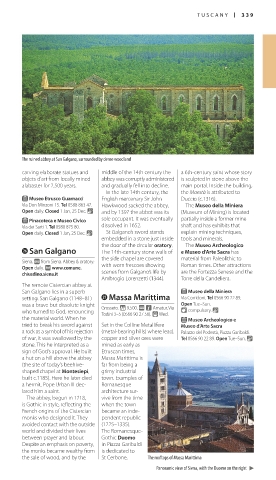
the sale of wood, and by the St Cerbone, The rooftops of Massa Marittima
Panoramic view of Siena, with the Duomo on the right
338-339_EW_Italy.indd 339 4/4/17 5:35 PM

