


Page 340 - (DK Eyewitness) Travel Guide - Italy
P. 340
338 CENTR AL IT AL Y
towers” with giants standing in walls still survive. The Museo
a moat. The perfectly preserved Etrusco Guarnacci contains
walls are best viewed from the one of the best collections of
Colle di Val d’Elsa road. Within Etruscan artifacts in Italy. Of
the walls, the sleepy town special interest is the group of
consists of a large piazza, a over 600 cinerary urns, made
pretty Romanesque church from alabaster or terracotta,
(on the piazza), a few houses, many of which were gathered
a couple of craft shops, from local tombs.
restaurants, and shops selling The Palazzo dei Priori, the
many of the locally produced medieval seat of government
Castello di Monteriggioni wines. on Piazza dei Priori, is the oldest
of its kind in
Environs Tuscany. It was
The landscape of the Crete Senesi West of begun in 1208
Monteriggioni and there are
a Crete Senesi by 3 km (2 miles) 14th-century
lies the former frescoes inside.
Asciano. V @ n Via delle Fonti
(0577 71 88 11). Cistercian Abbey The Pisan-
of Abbadia dell’ Romanesque
To the south of Siena and Isola (12th Duomo, located
central Tuscany is the area century). This on Piazza San
known as the Crete Senesi, Romanesque Giovanni, has a
which is characterized by round church was fine 13th-century
clay hillocks eroded by heavy largely rebuilt in pulpit with
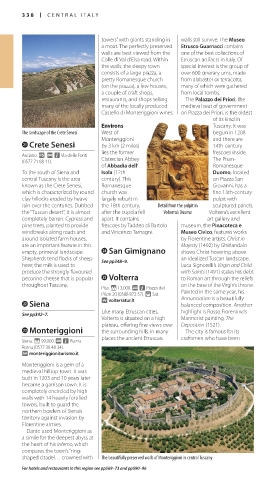
rain over the centuries. Dubbed the 18th century, Detail from the pulpit in sculptured panels.
the “Tuscan desert”, it is almost after the cupola fell Volterra’s Duomo Volterra’s excellent
completely barren. Cypress and apart. It con tains art gallery and
pine trees, planted to provide frescoes by Taddeo di Bartolo museum, the Pinacoteca e
windbreaks along roads and and Vincenzo Tamagni. Museo Civico, features works
around isolated farm houses, by Florentine artists. Christ in
are an important feature in this Majesty (1492) by Ghirlandaio
empty, primeval landscape. f San Gimignano shows Christ hovering above
Shepherds tend flocks of sheep See pp348–9. an idealized Tuscan landscape.
here; the milk is used to Luca Signorelli’s Virgin and Child
produce the strongly flavoured with Saints (1491) states his debt
pecorino cheese that is popular g Volterra to Roman art through the reliefs
throughout Tuscany. Pisa. * 13,000. @ n Piazza dei on the base of the Virgin’s throne.
Priori 20 (0588 872 57). ( Sat. Painted in the same year, his
s Siena ∑ volterratur.it Annunciation is a beautifully
balanced composition. Another
Like many Etruscan cities, highlight is Rosso Fiorentino’s
See pp342–7.
Volterra is situated on a high Mannerist painting, The
plateau, offering fine views over Deposition (1521).
d Monteriggioni the surrounding hills. In many The city is famous for its
places the ancient Etruscan craftsmen who have been
Siena. * 99,000. @ n Piazza
Roma (0577 30 48 34).
∑ monteriggioniturismo.it
Monteriggioni is a gem of a
medieval hilltop town. It was
built in 1203 and 10 years later
became a garrison town. It is
completely encircled by high
walls with 14 heavily fortified
towers, built to guard the
northern borders of Siena’s
territory against invasion by
Florentine armies.
Dante used Monteriggioni as
a simile for the deepest abyss at
the heart of his Inferno, which
compares the town’s “ring-
shaped citadel… crowned with The beautifully preserved walls of Monteriggioni in central Tuscany
For hotels and restaurants in this region see pp569–73 and pp590–96
338-339_EW_Italy.indd 338 4/4/17 5:35 PM

