


Page 347 - (DK Eyewitness) Travel Guide - Italy
P. 347
SIENA 345
P Palazzo Piccolomini
Piazza Pio II. Tel 0577 24 71 45.
Open 10am–6:30pm Tue–Sun (to
4:30pm Oct–Mar). Closed 7 Jan–
14 Feb, 16–30 Nov.
Siena’s most imposing private
palazzo was built for the wealthy
Piccolomini family in the 1460s
by the Florentine architect and
sculptor Bernardo Rossellino.
It now contains the Sienese
state archives, account books
and taxation documents dating
back to the 13th century. Some of
the leading artists of their day
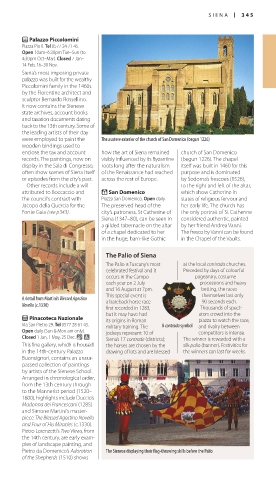
were employed to paint the The austere exterior of the church of San Domenico (begun 1226)
wooden bindings used to
enclose the tax and account how the art of Siena remained church of San Domenico
records. The paintings, now on visibly influenced by its Byzantine (begun 1226). The chapel
display in the Sala di Congresso, roots long after the naturalism itself was built in 1460 for this
often show scenes of Siena itself of the Renaissance had reached purpose and is dominated
or episodes from the city’s past. across the rest of Europe. by Sodoma’s frescoes (1526),
Other records include a will to the right and left of the altar,
attributed to Boccaccio and R San Domenico which show Catherine in
the council’s contract with Piazza San Domenico. Open daily. states of religious fervour and
Jacopo della Quercia for the The preserved head of the her early life. The church has
Fonte Gaia (see p343). city’s patroness, St Catherine of the only portrait of St Catherine
Siena (1347–80), can be seen in considered authentic, painted
a gilded tabernacle on the altar by her friend Andrea Vanni.
of a chapel dedicated to her The fresco by Vanni can be found
in the huge, barn-like Gothic in the Chapel of the Vaults.
The Palio of Siena
The Palio is Tuscany’s most at the local contrada churches.
celebrated festival and it Preceded by days of colourful
occurs in the Campo pageantry, costume
each year on 2 July processions and heavy
and 16 August at 7pm. betting, the races
This special event is themselves last only
A detail from Martini’s Blessed Agostino a bareback horse race 90 seconds each.
Novello (c.1330)
first recorded in 1283, Thousands of spect-
but it may have had ators crowd into the
E Pinacoteca Nazionale its origins in Roman piazza to watch the race,
Via San Pietro 29. Tel 0577 28 61 43. military training. The A contrada symbol and rivalry between
Open daily (Sun & Mon am only). jockeys represent 10 of competitors is intense.
Closed 1 Jan, 1 May, 25 Dec. & 7 Siena’s 17 contrade (districts); The winner is rewarded with a
This fine gallery, which is housed the horses are chosen by the silk palio (banner). Festivities for
in the 14th-century Palazzo drawing of lots and are blessed the winners can last for weeks.
Buonsignori, contains an unsur-
passed collection of paintings
by artists of the Sienese School.
Arranged in chronological order,
from the 13th century through
to the Mannerist period (1520–
1600), highlights include Duccio’s
Madonna dei Francescani (1285)
and Simone Martini’s master-
piece The Blessed Agostino Novello
and Four of His Miracles (c.1330).
Pietro Lorenzetti’s Two Views, from
the 14th century, are early exam-
ples of landscape painting, and
Pietro da Domenico’s Adoration The Sienese displaying their flag-throwing skills before the Palio
of the Shepherds (1510) shows
344-345_EW_Italy.indd 345 4/4/17 5:35 PM

